







A Letter to a Hindu: The New 2021 Translation
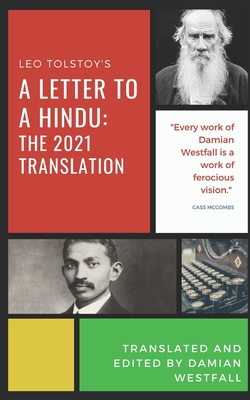
A Letter to a Hindu: The New 2021 Translation
Here is Tolstoy's masterpiece on nonviolence in the first new English translation in decades by Damian Westfall. Also included with A Letter to a Hindu is the complete correspondence between Tolstoy and Gandhi, an introduction by Gandhi and a new preface and epilogue by Damian Westfall the translator. In 1908 Tarak Nath Das, an Indian revolutionary and editor of "Free Hindustan", a magazine published to further the efforts of emancipating the Indians from the British colonial rule, sent Leo Tolstoy two issues of "Free Hindustan" and a letter explaining the oppression and subjugation of the people of India by the English and asked the world famous writer for advice on the best way to achieve freedom from the minority who enslaved 200,000,000 people and on December 14th, 1908, Tolstoy began writing what would be inevitably entitled "A Letter to a Hindu" in Russian, but it was soon translated into English by an anonymous writer and in 1909 Das published "A Letter to a Hindu" in an edition of "Free Hindustan", his magazine. A young lawyer turned activist who worked nonstop for the emancipation of India named Gandhi read Tolstoy's "A Letter to A Hindu" in "Free Hindustan" while living in South Africa where he resided with a population of 30,000 other Indians who were being oppressed and subjugated by the white Christians in the Transvaal province of South Africa. Gandhi was already a follower of Tolstoy after he read and was radicalized by Tolstoy's "The Kingdom of GOD is Within You" and immediately Gandhi knew he wanted to publish "A Letter to a Hindu" in his own magazine "Indian Opinion" that he was printing and distributing from Transvaal. And so, the young Gandhi wrote to Tolstoy to make sure that Tolstoy actually wrote the letter and asked Tolstoy if he, Gandhi Himself, could translate "A Letter to A Hindu" into the Indian dialect Guajarati and this began a correspondence of six letters between Gandhi and Tolstoy which concluded with Tolstoy's death in 1910 at 82 years old. The story of India's nonviolent revolution led by Gandhi is amazing and inspiring, but the reader of "A Letter to a Hindu" doesn't need to know all the details of the Indian problem presented by Tarak Nath, they are not necessary, because the Indian situation is used by Tolstoy only as an example. It is the theories presented by Tolstoy that are the guts of the letter, and at its center is the reason for publishing these texts, Tolstoy's thoughts on the concept of nonresistance to e
PRP: 46.50 Lei

Acesta este Prețul Recomandat de Producător. Prețul de vânzare al produsului este afișat mai jos.
41.85Lei
41.85Lei
46.50 LeiPrimești 41 puncte
Indisponibil
Descrierea produsului
Here is Tolstoy's masterpiece on nonviolence in the first new English translation in decades by Damian Westfall. Also included with A Letter to a Hindu is the complete correspondence between Tolstoy and Gandhi, an introduction by Gandhi and a new preface and epilogue by Damian Westfall the translator. In 1908 Tarak Nath Das, an Indian revolutionary and editor of "Free Hindustan", a magazine published to further the efforts of emancipating the Indians from the British colonial rule, sent Leo Tolstoy two issues of "Free Hindustan" and a letter explaining the oppression and subjugation of the people of India by the English and asked the world famous writer for advice on the best way to achieve freedom from the minority who enslaved 200,000,000 people and on December 14th, 1908, Tolstoy began writing what would be inevitably entitled "A Letter to a Hindu" in Russian, but it was soon translated into English by an anonymous writer and in 1909 Das published "A Letter to a Hindu" in an edition of "Free Hindustan", his magazine. A young lawyer turned activist who worked nonstop for the emancipation of India named Gandhi read Tolstoy's "A Letter to A Hindu" in "Free Hindustan" while living in South Africa where he resided with a population of 30,000 other Indians who were being oppressed and subjugated by the white Christians in the Transvaal province of South Africa. Gandhi was already a follower of Tolstoy after he read and was radicalized by Tolstoy's "The Kingdom of GOD is Within You" and immediately Gandhi knew he wanted to publish "A Letter to a Hindu" in his own magazine "Indian Opinion" that he was printing and distributing from Transvaal. And so, the young Gandhi wrote to Tolstoy to make sure that Tolstoy actually wrote the letter and asked Tolstoy if he, Gandhi Himself, could translate "A Letter to A Hindu" into the Indian dialect Guajarati and this began a correspondence of six letters between Gandhi and Tolstoy which concluded with Tolstoy's death in 1910 at 82 years old. The story of India's nonviolent revolution led by Gandhi is amazing and inspiring, but the reader of "A Letter to a Hindu" doesn't need to know all the details of the Indian problem presented by Tarak Nath, they are not necessary, because the Indian situation is used by Tolstoy only as an example. It is the theories presented by Tolstoy that are the guts of the letter, and at its center is the reason for publishing these texts, Tolstoy's thoughts on the concept of nonresistance to e
Detaliile produsului



