







Analysis of Chinese Characters
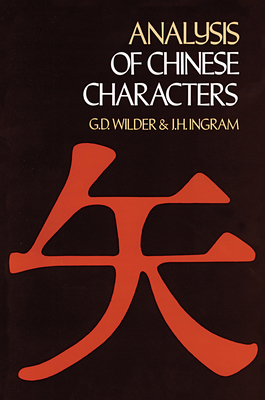
Analysis of Chinese Characters
Chinese characters were not formed arbitrarily, despite (to a Western eye) their overall similarity yet bewildering multiplicity in detail. Over several thousands of years, early religious writers, court officials, scholars, poets, and eventually lexicographers created a body of material that shows a remarkable internal system. A few characters were originally pictographic; a few were arbitrary; but more were the result of combining phonetic elements with semantic features.
This situation is not simply a historical curiosity, however; it offers a potentially great help to the student who is studying Chinese or Japanese characters, if he is aware of the patterns within the corpus of characters. In China and Japan, for hundreds of years, these derivational principles have been used as a teaching and mnemonic device; unfortunately, they have been greatly neglected in Western teaching.
This volume analyzes thoroughly, yet in simple language, some 1,000 Sino-Japanese characters, beginning with simple words like I, you, he, and the plural particle for pronouns, and works through a high-frequency vocabulary of characters. For each character it offers a printed form and, where such exists, a seal form; a transcription of the pronunciation into modern Mandarin, including tonal indications; and a full English translation. A body of text then explains the historical origin of the character, its semantic content, its components, including its radical in the traditional system. All this information is based on both the older compilations like the Shuo Wen and such modern studies as Wieger's monumental work.
This is far and away the most useful analysis of characters for the beginner or intermediate student. There is nothing else quite like it on the market. Full, clearly analyzed, faithful, it will make the learning of characters far easier and far more pleasant than brute memory. It should be owned by every student and teacher of Chinese or Japanese.
PRP: 154.69 Lei

Acesta este Prețul Recomandat de Producător. Prețul de vânzare al produsului este afișat mai jos.
123.75Lei
123.75Lei
154.69 LeiPrimești 123 puncte
Indisponibil
Descrierea produsului
Chinese characters were not formed arbitrarily, despite (to a Western eye) their overall similarity yet bewildering multiplicity in detail. Over several thousands of years, early religious writers, court officials, scholars, poets, and eventually lexicographers created a body of material that shows a remarkable internal system. A few characters were originally pictographic; a few were arbitrary; but more were the result of combining phonetic elements with semantic features.
This situation is not simply a historical curiosity, however; it offers a potentially great help to the student who is studying Chinese or Japanese characters, if he is aware of the patterns within the corpus of characters. In China and Japan, for hundreds of years, these derivational principles have been used as a teaching and mnemonic device; unfortunately, they have been greatly neglected in Western teaching.
This volume analyzes thoroughly, yet in simple language, some 1,000 Sino-Japanese characters, beginning with simple words like I, you, he, and the plural particle for pronouns, and works through a high-frequency vocabulary of characters. For each character it offers a printed form and, where such exists, a seal form; a transcription of the pronunciation into modern Mandarin, including tonal indications; and a full English translation. A body of text then explains the historical origin of the character, its semantic content, its components, including its radical in the traditional system. All this information is based on both the older compilations like the Shuo Wen and such modern studies as Wieger's monumental work.
This is far and away the most useful analysis of characters for the beginner or intermediate student. There is nothing else quite like it on the market. Full, clearly analyzed, faithful, it will make the learning of characters far easier and far more pleasant than brute memory. It should be owned by every student and teacher of Chinese or Japanese.
Detaliile produsului



