








Black Grief/White Grievance: The Politics of Loss
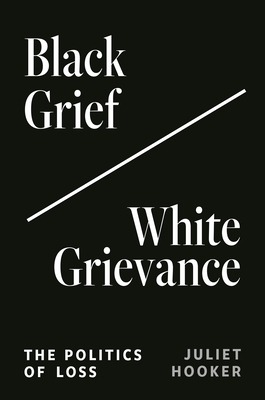
Black Grief/White Grievance: The Politics of Loss
How race shapes expectations about whose losses matter
In democracies, citizens must accept loss; we can't always be on the winning side. But in the United States, the fundamental civic capacity of being able to lose is not distributed equally. Propped up by white supremacy, whites (as a group) are accustomed to winning; they have generally been able to exercise political rule without having to accept sharing it. Black citizens, on the other hand, are expected to be political heroes whose civic suffering enables progress toward racial justice. In this book, Juliet Hooker, a leading thinker on democracy and race, argues that the two most important forces driving racial politics in the United States today are Black grief and white grievance. Black grief is exemplified by current protests against police violence--the latest in a tradition of violent death and subsequent public mourning spurring Black political mobilization. The potent politics of white grievance, meanwhile, which is also not new, imagines the United States as a white country under siege. Drawing on African American political thought, Hooker examines key moments in US racial politics that illuminate the problem of loss in democracy. She connects today's Black Lives Matter protests to the use of lynching photographs to arouse public outrage over post-Reconstruction era racial terror, and she discusses Emmett Till's funeral as a catalyst for the civil rights struggles of the 1950s and 1960s. She also traces the political weaponization of white victimhood during the Obama and Trump presidencies. Calling for an expansion of Black and white political imaginations, Hooker argues that both must learn to sit with loss, for different reasons and to different ends.PRP: 215.79 Lei

Acesta este Prețul Recomandat de Producător. Prețul de vânzare al produsului este afișat mai jos.
194.21Lei
194.21Lei
215.79 LeiPrimești 194 puncte

Indisponibil
Descrierea produsului
How race shapes expectations about whose losses matter
In democracies, citizens must accept loss; we can't always be on the winning side. But in the United States, the fundamental civic capacity of being able to lose is not distributed equally. Propped up by white supremacy, whites (as a group) are accustomed to winning; they have generally been able to exercise political rule without having to accept sharing it. Black citizens, on the other hand, are expected to be political heroes whose civic suffering enables progress toward racial justice. In this book, Juliet Hooker, a leading thinker on democracy and race, argues that the two most important forces driving racial politics in the United States today are Black grief and white grievance. Black grief is exemplified by current protests against police violence--the latest in a tradition of violent death and subsequent public mourning spurring Black political mobilization. The potent politics of white grievance, meanwhile, which is also not new, imagines the United States as a white country under siege. Drawing on African American political thought, Hooker examines key moments in US racial politics that illuminate the problem of loss in democracy. She connects today's Black Lives Matter protests to the use of lynching photographs to arouse public outrage over post-Reconstruction era racial terror, and she discusses Emmett Till's funeral as a catalyst for the civil rights struggles of the 1950s and 1960s. She also traces the political weaponization of white victimhood during the Obama and Trump presidencies. Calling for an expansion of Black and white political imaginations, Hooker argues that both must learn to sit with loss, for different reasons and to different ends.Detaliile produsului