



- /
- Librarie online
- /
- Carti in engleza
- /
- Science
- /
- Time
- /
- A Brief History of Timekeeping: The Science of Marking Time, from Stonehenge to Atomic Clocks - Chad Orzel
A Brief History of Timekeeping: The Science of Marking Time, from Stonehenge to Atomic Clocks
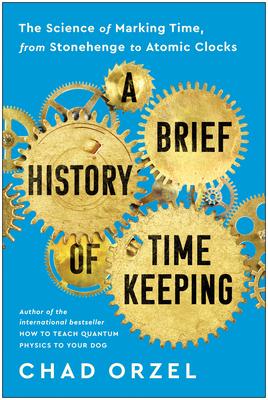
A Brief History of Timekeeping: The Science of Marking Time, from Stonehenge to Atomic Clocks
A wonderful look into understanding and recording time, Orzel's latest is appropriate for all readers who are curious about those ticks and tocks that mark nearly every aspect of our lives.
--Booklist "A thorough, enjoyable exploration of the history and science behind measuring time."
--Foreword Reviews
It's all a matter of time--literally. From the movements of the spheres to the slipperiness of relativity, the story of science unfolds through the fascinating history of humanity's efforts to keep time. Our modern lives are ruled by clocks and watches, smartphone apps and calendar programs. While our gadgets may be new, however, the drive to measure and master time is anything but--and in A Brief History of Timekeeping, Chad Orzel traces the path from Stonehenge to your smartphone. Predating written language and marching on through human history, the desire for ever-better timekeeping has spurred technological innovation and sparked theories that radically reshaped our understanding of the universe and our place in it. Orzel, a physicist and the bestselling author of Breakfast with Einstein and How to Teach Quantum Physics to Your Dog continues his tradition of demystifying thorny scientific concepts by using the clocks and calendars central to our everyday activities as a jumping-off point to explore the science underlying the ways we keep track of our time. Ancient solstice markers (which still work perfectly 5,000 years later) depend on the basic astrophysics of our solar system; mechanical clocks owe their development to Newtonian physics; and the ultra-precise atomic timekeeping that enables GPS hinges on the predictable oddities of quantum mechanics. Along the way, Orzel visits the delicate negotiations involved in Gregorian calendar reform, the intricate and entirely unique system employed by the Maya, and how the problem of synchronizing clocks at different locations ultimately required us to abandon the idea of time as an absolute and universal quantity. Sharp and engaging, A Brief History of Timekeeping is a story not just about the science of sundials, sandglasses, and mechanical clocks, but also the politics of calendars and time zones, the philosophy of measurement, and the nature of space and time itself. For those interested in science, technology, or history, or anyone who's ever wondered about the instruments that divide our days into moments: the time you spend reading this book may fly, and it is certain to be well
PRP: 105.09 Lei

Acesta este Prețul Recomandat de Producător. Prețul de vânzare al produsului este afișat mai jos.
94.58Lei
94.58Lei
105.09 LeiPrimești 94 puncte

Indisponibil
Descrierea produsului
A wonderful look into understanding and recording time, Orzel's latest is appropriate for all readers who are curious about those ticks and tocks that mark nearly every aspect of our lives.
--Booklist "A thorough, enjoyable exploration of the history and science behind measuring time."
--Foreword Reviews
It's all a matter of time--literally. From the movements of the spheres to the slipperiness of relativity, the story of science unfolds through the fascinating history of humanity's efforts to keep time. Our modern lives are ruled by clocks and watches, smartphone apps and calendar programs. While our gadgets may be new, however, the drive to measure and master time is anything but--and in A Brief History of Timekeeping, Chad Orzel traces the path from Stonehenge to your smartphone. Predating written language and marching on through human history, the desire for ever-better timekeeping has spurred technological innovation and sparked theories that radically reshaped our understanding of the universe and our place in it. Orzel, a physicist and the bestselling author of Breakfast with Einstein and How to Teach Quantum Physics to Your Dog continues his tradition of demystifying thorny scientific concepts by using the clocks and calendars central to our everyday activities as a jumping-off point to explore the science underlying the ways we keep track of our time. Ancient solstice markers (which still work perfectly 5,000 years later) depend on the basic astrophysics of our solar system; mechanical clocks owe their development to Newtonian physics; and the ultra-precise atomic timekeeping that enables GPS hinges on the predictable oddities of quantum mechanics. Along the way, Orzel visits the delicate negotiations involved in Gregorian calendar reform, the intricate and entirely unique system employed by the Maya, and how the problem of synchronizing clocks at different locations ultimately required us to abandon the idea of time as an absolute and universal quantity. Sharp and engaging, A Brief History of Timekeeping is a story not just about the science of sundials, sandglasses, and mechanical clocks, but also the politics of calendars and time zones, the philosophy of measurement, and the nature of space and time itself. For those interested in science, technology, or history, or anyone who's ever wondered about the instruments that divide our days into moments: the time you spend reading this book may fly, and it is certain to be well
Detaliile produsului