








Assyrian and biblical chronologies are they reliable?
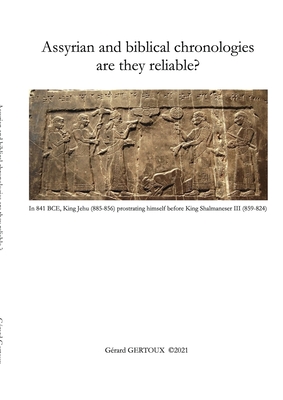
Assyrian and biblical chronologies are they reliable?
The Assyrian chronology of the first millennium BCE is well established, especially for the period 912-609 BCE, but it is difficult to determine whether there were overlapping reigns due to possible co-regencies. Assyriologists have assumed that there were no co-regencies among the Assyrian reigns. Based on this assumption, Edwin R. Thiele, in his thesis published in 1951, established a chronology of the Hebrew kings, relying on the numerous synchronisms with the Assyrian kings, but several of the required synchronisms exhibited gaps ranging from 10 to 45 years. He solved this problem by assuming the existence of nine co-regencies among the Hebrew reigns. Despite this choice, which destroys the chronological coherence of the Hebrew reigns, Thiele's chronology still serves as a reference for scholars. However, a careful examination of these synchronisms shows that there were several co-regencies among the Assyrian reigns, which they have been correctly dated in the biblical chronology, such as those of Sennacherib and Tiglath-Pileser III. These kings played a crucial role in Israel's history during their co-regencies, such as Sennacherib's campaign in Judah (his 3rd) with the siege of Lachish and Jerusalem, which took place in 712 BCE during the 10th campaign of Sargon II (722-705) with whom he was co-regent (715-705). This agrees exactly with the biblical account stating that all these events occurred during the 14th year of Judean King Hezekiah (726-697) also dated 712 BCE. Similarly, the Israelite king Menahem (771-760) had to pay a tribute (in 765 BCE) to an Assyrian king Pul (2Ki 15:19-20). The Assyrian word pulu, from apil/aplu, means "the heir (i.e., crown prince)". King Pul(as) reigned 36 years, according to Josephus (Jewish Antiquities IX: 283-287), which corresponds exactly to the Assyrian king Pulu (co-regent) known by his Aramaic name Bar-Ga'yah "Son of the Majesty" who reigned from 782 to 746 BCE.
PRP: 86.80 Lei

Acesta este Prețul Recomandat de Producător. Prețul de vânzare al produsului este afișat mai jos.
78.12Lei
78.12Lei
86.80 LeiPrimești 78 puncte

Indisponibil
Descrierea produsului
The Assyrian chronology of the first millennium BCE is well established, especially for the period 912-609 BCE, but it is difficult to determine whether there were overlapping reigns due to possible co-regencies. Assyriologists have assumed that there were no co-regencies among the Assyrian reigns. Based on this assumption, Edwin R. Thiele, in his thesis published in 1951, established a chronology of the Hebrew kings, relying on the numerous synchronisms with the Assyrian kings, but several of the required synchronisms exhibited gaps ranging from 10 to 45 years. He solved this problem by assuming the existence of nine co-regencies among the Hebrew reigns. Despite this choice, which destroys the chronological coherence of the Hebrew reigns, Thiele's chronology still serves as a reference for scholars. However, a careful examination of these synchronisms shows that there were several co-regencies among the Assyrian reigns, which they have been correctly dated in the biblical chronology, such as those of Sennacherib and Tiglath-Pileser III. These kings played a crucial role in Israel's history during their co-regencies, such as Sennacherib's campaign in Judah (his 3rd) with the siege of Lachish and Jerusalem, which took place in 712 BCE during the 10th campaign of Sargon II (722-705) with whom he was co-regent (715-705). This agrees exactly with the biblical account stating that all these events occurred during the 14th year of Judean King Hezekiah (726-697) also dated 712 BCE. Similarly, the Israelite king Menahem (771-760) had to pay a tribute (in 765 BCE) to an Assyrian king Pul (2Ki 15:19-20). The Assyrian word pulu, from apil/aplu, means "the heir (i.e., crown prince)". King Pul(as) reigned 36 years, according to Josephus (Jewish Antiquities IX: 283-287), which corresponds exactly to the Assyrian king Pulu (co-regent) known by his Aramaic name Bar-Ga'yah "Son of the Majesty" who reigned from 782 to 746 BCE.
Detaliile produsului




