



- /
- Librarie online
- /
- Carti in engleza
- /
- Mathematics
- /
- General
- /
- Fourier Analysis: " Decomposing a Waveform Into a Harmonic Series " - Paul F. Kisak
Fourier Analysis: ' Decomposing a Waveform Into a Harmonic Series '
Fourier Analysis: ' Decomposing a Waveform Into a Harmonic Series '
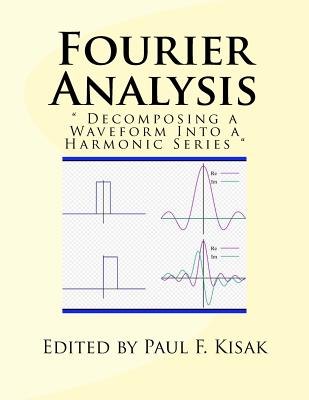
In mathematics, Fourier analysis is the study of the way general functions may be represented or approximated by sums of simpler trigonometric functions. Fourier analysis grew from the study of Fourier series, and is named after Joseph Fourier, who showed that representing a function as a sum of trigonometric functions greatly simplifies the study of heat transfer.Today, the subject of Fourier analysis encompasses a vast spectrum of mathematics. In the sciences and engineering, the process of decomposing a function into oscillatory components is often called a Fourier transform, while the operation of rebuilding the function from these pieces is known as Fourier synthesis. For example, determining what component frequencies are present in a musical note would involve computing the Fourier transform of a sampled musical note. One could then re-synthesize the same sound by including the frequency components as revealed in the Fourier analysis. In mathematics, the term Fourier analysis often refers to the study of both operations.The decomposition process itself is called a Fourier transformation. Its output, the Fourier transform, is often given a more specific name, which depends upon the domain and other properties of the function being transformed. Moreover, the original concept of Fourier analysis has been extended over time to apply to more and more abstract and general situations, and the general field is often known as harmonic analysis. Each transform used for analysis (see list of Fourier-related transforms) has a corresponding inverse transform that can be used for synthesis.This book discusses the history, applications and development of Fourier analysis and the Fourier Transform and is designed to be a reference and provide an overview of the topic and give the reader a structured knowledge to familiarize yourself with the topic at the most affordable price possible.The accuracy and knowledge is of an international viewpoint as the edited articles represent the inputs of many knowledgeable individuals and some of the most current knowledge on the topic, based on the date of publication.
PRP: 115.86 Lei

Acesta este Prețul Recomandat de Producător. Prețul de vânzare al produsului este afișat mai jos.
104.27Lei
104.27Lei
115.86 LeiPrimești 104 puncte

Livrare in 2-4 saptamani
Descrierea produsului
In mathematics, Fourier analysis is the study of the way general functions may be represented or approximated by sums of simpler trigonometric functions. Fourier analysis grew from the study of Fourier series, and is named after Joseph Fourier, who showed that representing a function as a sum of trigonometric functions greatly simplifies the study of heat transfer.Today, the subject of Fourier analysis encompasses a vast spectrum of mathematics. In the sciences and engineering, the process of decomposing a function into oscillatory components is often called a Fourier transform, while the operation of rebuilding the function from these pieces is known as Fourier synthesis. For example, determining what component frequencies are present in a musical note would involve computing the Fourier transform of a sampled musical note. One could then re-synthesize the same sound by including the frequency components as revealed in the Fourier analysis. In mathematics, the term Fourier analysis often refers to the study of both operations.The decomposition process itself is called a Fourier transformation. Its output, the Fourier transform, is often given a more specific name, which depends upon the domain and other properties of the function being transformed. Moreover, the original concept of Fourier analysis has been extended over time to apply to more and more abstract and general situations, and the general field is often known as harmonic analysis. Each transform used for analysis (see list of Fourier-related transforms) has a corresponding inverse transform that can be used for synthesis.This book discusses the history, applications and development of Fourier analysis and the Fourier Transform and is designed to be a reference and provide an overview of the topic and give the reader a structured knowledge to familiarize yourself with the topic at the most affordable price possible.The accuracy and knowledge is of an international viewpoint as the edited articles represent the inputs of many knowledgeable individuals and some of the most current knowledge on the topic, based on the date of publication.
Detaliile produsului