- /
- Librarie online
- /
- Carti in engleza
- /
- Literary Criticism
- /
- Shakespeare
- /
- History Play: The Lives and After-Life of Christopher Marlowe - Rodney Bolt
History Play: The Lives and After-Life of Christopher Marlowe
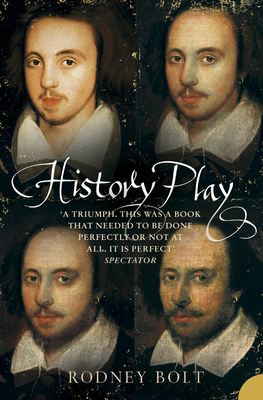
History Play: The Lives and After-Life of Christopher Marlowe
What if Christopher Marlowe staged his own death, fled to the Continent and went on to write the works we now attribute to Shakespeare? 'About anyone so great as Shakespeare, it is probable that we can never be right; and if we can never be right, it is better that we should from time to time change our way of being wrong.' T. S. Eliot Mark Twain likened writing the biography of Shakespeare to reconstructing the skeleton of a brontosaurus - using 'nine bones and six hundred barrels of plaster of Paris'. We work with a handful of facts and a pile of conjecture. All biographies of Shakespeare, from the wayward to the academic, use the same few-score hard facts kneaded together with legend, then leavened by a dash of zeitgeist and a large dollop of author's imagination. Poems and plays are plundered for booty, even by those who profess scepticism as to the inferences that can be drawn about the life from the work. Like statistics, quotations can be turned to very different facts. This book is not, of course, an attempt to prove that Christopher Marlowe staged his own death, fled to the continent, and went on to write the work attributed to Shakespeare. It, however, playfully assumes that as its starting point, and swings the old bones around, viewing them from a different angle to build a different brontosaurus. It does so in a spirit of fun, and with the intention of a little saucy iconoclasm. Shakespeare's works are unassailable, and will survive any amount of subversion, but by playing with our commonplace history, Rodney Bolt argues that the quasi-religious idol the man has become is perhaps in need of the efforts of a wicked woodworm. Where other writers have looked at the evidence and deduced a story, Bolt has imagined a story, then supported it with the same sparse evidence. At this distance, the difference between deduction and speculation is paper thin. The point of the take is not only to question our view of history and the validity of biography, but to show how people travelled, how cultures crossed, and how art gets made.
PRP: 99.13 Lei

Acesta este Prețul Recomandat de Producător. Prețul de vânzare al produsului este afișat mai jos.
89.22Lei
89.22Lei
99.13 LeiPrimești 89 puncte

Livrare in 2-4 saptamani
Descrierea produsului
What if Christopher Marlowe staged his own death, fled to the Continent and went on to write the works we now attribute to Shakespeare? 'About anyone so great as Shakespeare, it is probable that we can never be right; and if we can never be right, it is better that we should from time to time change our way of being wrong.' T. S. Eliot Mark Twain likened writing the biography of Shakespeare to reconstructing the skeleton of a brontosaurus - using 'nine bones and six hundred barrels of plaster of Paris'. We work with a handful of facts and a pile of conjecture. All biographies of Shakespeare, from the wayward to the academic, use the same few-score hard facts kneaded together with legend, then leavened by a dash of zeitgeist and a large dollop of author's imagination. Poems and plays are plundered for booty, even by those who profess scepticism as to the inferences that can be drawn about the life from the work. Like statistics, quotations can be turned to very different facts. This book is not, of course, an attempt to prove that Christopher Marlowe staged his own death, fled to the continent, and went on to write the work attributed to Shakespeare. It, however, playfully assumes that as its starting point, and swings the old bones around, viewing them from a different angle to build a different brontosaurus. It does so in a spirit of fun, and with the intention of a little saucy iconoclasm. Shakespeare's works are unassailable, and will survive any amount of subversion, but by playing with our commonplace history, Rodney Bolt argues that the quasi-religious idol the man has become is perhaps in need of the efforts of a wicked woodworm. Where other writers have looked at the evidence and deduced a story, Bolt has imagined a story, then supported it with the same sparse evidence. At this distance, the difference between deduction and speculation is paper thin. The point of the take is not only to question our view of history and the validity of biography, but to show how people travelled, how cultures crossed, and how art gets made.
Detaliile produsului