








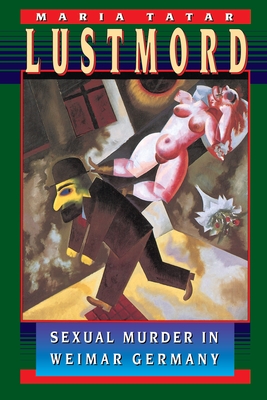
In a book that confronts our society's obsession with sexual violence and the image of the violated female corpse in our collective consciousness, Harvard culturist Maria Tatar examines images of sexual murder and studies how art and murder have intersected in sexual culture from Weimar Germany to the present. 44 photos.
In a book that confronts our society's obsession with sexual violence, Maria Tatar seeks the meaning behind one of the most disturbing images of twentieth-century Western culture: the violated female corpse. This image is so prevalent in painting, literature, film, and, most recently, in mass media, that we rarely question what is at stake in its representation. Tatar, however, challenges us to consider what is taking place--both artistically and socially--in the construction and circulation of scenes depicting sexual murder. In examining images of sexual murder (Lustmord), she produces a riveting study of how art and murder have intersected in the sexual politics of culture from Weimar Germany to the present. Tatar focuses attention on the politically turbulent Weimar Republic, often viewed as the birthplace of a transgressive avant-garde modernism, where representations of female sexual mutilation abound. Here a revealing episode in the gender politics of cultural production unfolds as male artists and writers, working in a society consumed by fear of outside threats, envision women as enemies that can be contained and mastered through transcendent artistic expression. Not only does Tatar show that male artists openly identified with real-life sexual murderers--George Grosz posed as Jack the Ripper in a photograph where his model and future wife was the target of his knife--but she also reveals the ways in which victims were disavowed and erased. Tatar first analyzes actual cases of sexual murder that aroused wide public interest in Weimar Germany. She then considers how the representation of murdered women in visual and literary works functions as a strategy for managing social and sexual anxieties, and shows how violence against women can be linked to the war trauma, to urban pathologies, and to the politics of cultural production and biological reproduction. In exploring the complex relationship between victim and agent in cases of sexual murder, Tatar explains how the roles came to be destabilized and reversed, turning the perpetrator of criminal deeds into a defenseless victim of seductive evil. Throughou
In a book that confronts our society's obsession with sexual violence, Maria Tatar seeks the meaning behind one of the most disturbing images of twentieth-century Western culture: the violated female corpse. This image is so prevalent in painting, literature, film, and, most recently, in mass media, that we rarely question what is at stake in its representation. Tatar, however, challenges us to consider what is taking place--both artistically and socially--in the construction and circulation of scenes depicting sexual murder. In examining images of sexual murder (Lustmord), she produces a riveting study of how art and murder have intersected in the sexual politics of culture from Weimar Germany to the present. Tatar focuses attention on the politically turbulent Weimar Republic, often viewed as the birthplace of a transgressive avant-garde modernism, where representations of female sexual mutilation abound. Here a revealing episode in the gender politics of cultural production unfolds as male artists and writers, working in a society consumed by fear of outside threats, envision women as enemies that can be contained and mastered through transcendent artistic expression. Not only does Tatar show that male artists openly identified with real-life sexual murderers--George Grosz posed as Jack the Ripper in a photograph where his model and future wife was the target of his knife--but she also reveals the ways in which victims were disavowed and erased. Tatar first analyzes actual cases of sexual murder that aroused wide public interest in Weimar Germany. She then considers how the representation of murdered women in visual and literary works functions as a strategy for managing social and sexual anxieties, and shows how violence against women can be linked to the war trauma, to urban pathologies, and to the politics of cultural production and biological reproduction. In exploring the complex relationship between victim and agent in cases of sexual murder, Tatar explains how the roles came to be destabilized and reversed, turning the perpetrator of criminal deeds into a defenseless victim of seductive evil. Throughou





