








Marine Advisors: With the Vietnamese Provincial Reconnaissance Units, 1966-1970
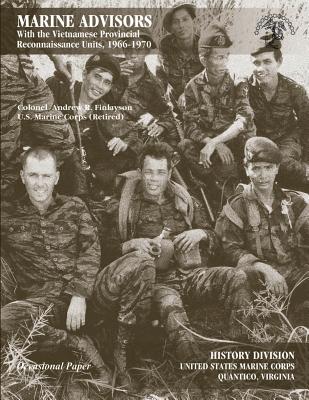
Marine Advisors: With the Vietnamese Provincial Reconnaissance Units, 1966-1970
U.S. Marines as advisors have a long history, from Presley O'Bannon at Tripoli through Iraq and Afghanistan via Haiti, Dominican Republic, Nicaragua, China, South Korea, Taiwan, Philippines, and Vietnam. While most Marines think of the Vietnamese Marine Corps as the primary advisory experience during that conflict, others served with various other advisory programs with the U.S. Army, U.S. Navy, U.S. Joint Special Operations, and U.S. Civil Operations and Rural Development Support. One of these is the subject of this study: Marine advisors with the Vietnamese Provincial Reconnaissance Units (PRUs). This narrative is a combination of experience, research, and reflection. While other journalistic or academic accounts have been published, this is a narrative of participants. Many historians consider the two most effective counterinsurgency organizations employed during the Vietnam War to have been the PRU and USMC Combined Action Platoons (CAP). In both cases, U.S. Marines played a significant role in the success of these innovative programs. It should be pointed out, however, that the number of U.S. Marines assigned to these programs was small and the bulk of the forces were locally recruited fighters. Both programs used a small cadre of Marines providing leadership, training, and combat support for large numbers of indigenous troops, and in so doing, capitalized on the inherent strengths of each. The author believes that both of these programs have applicability in any counterinsurgency where U.S. forces are called upon to assist a host government. Obviously, adjustments to these programs would have to be made to take into account local conditions, but the core concept of providing U.S. Marines to command or advise local militia and special police units is one that has great promise for success. With a clear understanding of why the PRUs and CAPs worked, and with the necessary adjustments to take into account local conditions, similar units can be created to defeat future insurgencies. With this in mind, the author hopes that this work will provide U.S. military planners with insights into creating and managing units capable of defeating a well-organized and highly motivated insurgent political infrastructure.
PRP: 81.30 Lei

Acesta este Prețul Recomandat de Producător. Prețul de vânzare al produsului este afișat mai jos.
73.17Lei
73.17Lei
81.30 LeiPrimești 73 puncte

Livrare in 2-4 saptamani
Descrierea produsului
U.S. Marines as advisors have a long history, from Presley O'Bannon at Tripoli through Iraq and Afghanistan via Haiti, Dominican Republic, Nicaragua, China, South Korea, Taiwan, Philippines, and Vietnam. While most Marines think of the Vietnamese Marine Corps as the primary advisory experience during that conflict, others served with various other advisory programs with the U.S. Army, U.S. Navy, U.S. Joint Special Operations, and U.S. Civil Operations and Rural Development Support. One of these is the subject of this study: Marine advisors with the Vietnamese Provincial Reconnaissance Units (PRUs). This narrative is a combination of experience, research, and reflection. While other journalistic or academic accounts have been published, this is a narrative of participants. Many historians consider the two most effective counterinsurgency organizations employed during the Vietnam War to have been the PRU and USMC Combined Action Platoons (CAP). In both cases, U.S. Marines played a significant role in the success of these innovative programs. It should be pointed out, however, that the number of U.S. Marines assigned to these programs was small and the bulk of the forces were locally recruited fighters. Both programs used a small cadre of Marines providing leadership, training, and combat support for large numbers of indigenous troops, and in so doing, capitalized on the inherent strengths of each. The author believes that both of these programs have applicability in any counterinsurgency where U.S. forces are called upon to assist a host government. Obviously, adjustments to these programs would have to be made to take into account local conditions, but the core concept of providing U.S. Marines to command or advise local militia and special police units is one that has great promise for success. With a clear understanding of why the PRUs and CAPs worked, and with the necessary adjustments to take into account local conditions, similar units can be created to defeat future insurgencies. With this in mind, the author hopes that this work will provide U.S. military planners with insights into creating and managing units capable of defeating a well-organized and highly motivated insurgent political infrastructure.
Detaliile produsului