



- /
- Librarie online
- /
- Carti in engleza
- /
- Philosophy
- /
- Ethics & Moral Philosophy
- /
- Natural Law: The Scientific Ways of Treating Natural Law, Its Place in Moral Philosophy, and Its Relation to the Positive Sciences - G. W. F. Hegel
Natural Law: The Scientific Ways of Treating Natural Law, Its Place in Moral Philosophy, and Its Relation to the Positive Sciences
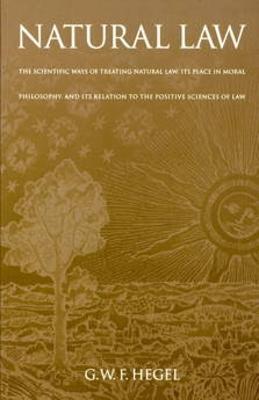
One of the central problems in the history of moral and political philosophy since antiquity has been to explain how human society and its civil institutions came into being. In attempting to solve this problem philosophers developed the idea of natural law, which for many centuries was used to describe the system of fundamental, rational principles presumed universally to govern human behavior in society. By the eighteenth century the doctrine of natural law had engendered the related doctrine of natural rights, which gained reinforcement most famously in the American and French revolutions. According to this view, human society arose through the association of individuals who might have chosen to live alone in scattered isolation and who, in coming together, were regarded as entering into a social contract.
In this important early essay, first published in English in this definitive translation in 1975 and now returned to print, Hegel utterly rejects the notion that society is purposely formed by voluntary association. Indeed, he goes further than this, asserting in effect that the laws brought about in various countries in response to force, accident, and deliberation are far more fundamental than any law of nature supposed to be valid always and everywhere. In expounding his view Hegel not only dispenses with the empiricist explanations of Hobbes, Hume, and others but also, at the heart of this work, offers an extended critique of the so-called formalist positions of Kant and Fichte.PRP: 193.36 Lei

Acesta este Prețul Recomandat de Producător. Prețul de vânzare al produsului este afișat mai jos.
174.02Lei
174.02Lei
193.36 LeiPrimești 174 puncte

Livrare in 2-4 saptamani
Descrierea produsului
One of the central problems in the history of moral and political philosophy since antiquity has been to explain how human society and its civil institutions came into being. In attempting to solve this problem philosophers developed the idea of natural law, which for many centuries was used to describe the system of fundamental, rational principles presumed universally to govern human behavior in society. By the eighteenth century the doctrine of natural law had engendered the related doctrine of natural rights, which gained reinforcement most famously in the American and French revolutions. According to this view, human society arose through the association of individuals who might have chosen to live alone in scattered isolation and who, in coming together, were regarded as entering into a social contract.
In this important early essay, first published in English in this definitive translation in 1975 and now returned to print, Hegel utterly rejects the notion that society is purposely formed by voluntary association. Indeed, he goes further than this, asserting in effect that the laws brought about in various countries in response to force, accident, and deliberation are far more fundamental than any law of nature supposed to be valid always and everywhere. In expounding his view Hegel not only dispenses with the empiricist explanations of Hobbes, Hume, and others but also, at the heart of this work, offers an extended critique of the so-called formalist positions of Kant and Fichte.Detaliile produsului