








New Orleans Carnival Balls: The Secret Side of Mardi Gras, 1870-1920
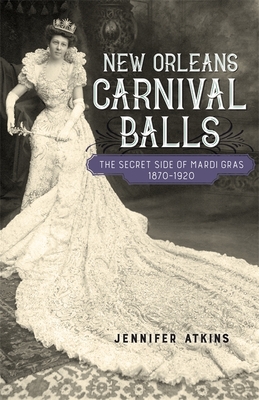
New Orleans Carnival Balls: The Secret Side of Mardi Gras, 1870-1920
Mardi Gras festivities don't end after the parades roll through the streets; rather, a large part of the celebration continues unseen by the general public. Retreating to theaters, convention centers, and banquet halls, krewes spend the post-parade evening at lavish balls, where members cultivate a sense of fraternity and reinforce the organization's shared values through pageantry and dance. In New Orleans Carnival Balls, Jennifer Atkins draws back the curtain on the origin of these exclusive soirees, bringing to light unique traditions unseen by outsiders.
The oldest Carnival organizations--the Mistick Krewe of Comus, Twelfth Night Revelers, Krewe of Proteus, Knights of Momus, and Rex--emerged in the mid-nineteenth century. These old-line krewes ruled Mardi Gras from the Civil War until World War I, and the traditions of their private balls reflected a need for group solidarity amidst a world in flux. For these organizations, Carnival balls became magical realms where krewesmen reinforced their elite identity through sculpted tableaux vivants performances, mock coronations, and romantic ballroom dancing. This world was full of possibilities: krewesmen became gods, kings, and knights, while their daughters became queens and maids. As the old-line krewes cultivated a sense of brotherhood, they used costume and movement to reaffirm their group identity, and the crux of these performances relied on a specific mode of expression--dancing. Using the concept of dance as a lens for examining Carnival balls, Atkins delves deeper into the historical context and distinctive rituals of Mardi Gras in New Orleans. Beyond presenting readers with a new means of thinking about Carnival traditions, Atkins's work situates dance as a vital piece of historical inquiry and a mode of study that sheds new light on the hidden practices of some of the best-known krewes in the Big Easy.--Kim Vaz-Deville, author of The "Baby Dolls" Breaking the Race and Gender Barriers of the New Orleans Mardi Gras TraditionPRP: 278.69 Lei

Acesta este Prețul Recomandat de Producător. Prețul de vânzare al produsului este afișat mai jos.
250.82Lei
250.82Lei
278.69 LeiPrimești 250 puncte

Indisponibil
Descrierea produsului
Mardi Gras festivities don't end after the parades roll through the streets; rather, a large part of the celebration continues unseen by the general public. Retreating to theaters, convention centers, and banquet halls, krewes spend the post-parade evening at lavish balls, where members cultivate a sense of fraternity and reinforce the organization's shared values through pageantry and dance. In New Orleans Carnival Balls, Jennifer Atkins draws back the curtain on the origin of these exclusive soirees, bringing to light unique traditions unseen by outsiders.
The oldest Carnival organizations--the Mistick Krewe of Comus, Twelfth Night Revelers, Krewe of Proteus, Knights of Momus, and Rex--emerged in the mid-nineteenth century. These old-line krewes ruled Mardi Gras from the Civil War until World War I, and the traditions of their private balls reflected a need for group solidarity amidst a world in flux. For these organizations, Carnival balls became magical realms where krewesmen reinforced their elite identity through sculpted tableaux vivants performances, mock coronations, and romantic ballroom dancing. This world was full of possibilities: krewesmen became gods, kings, and knights, while their daughters became queens and maids. As the old-line krewes cultivated a sense of brotherhood, they used costume and movement to reaffirm their group identity, and the crux of these performances relied on a specific mode of expression--dancing. Using the concept of dance as a lens for examining Carnival balls, Atkins delves deeper into the historical context and distinctive rituals of Mardi Gras in New Orleans. Beyond presenting readers with a new means of thinking about Carnival traditions, Atkins's work situates dance as a vital piece of historical inquiry and a mode of study that sheds new light on the hidden practices of some of the best-known krewes in the Big Easy.--Kim Vaz-Deville, author of The "Baby Dolls" Breaking the Race and Gender Barriers of the New Orleans Mardi Gras TraditionDetaliile produsului




