








On taste, On the sublime and beautiful, Reflections on the French Revolution, A letter to a noble lord. With introd. and notes. By: Edmund Burke: Edmu
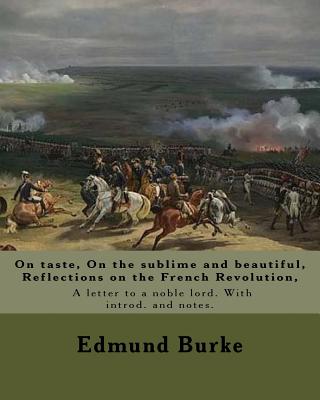
On taste, On the sublime and beautiful, Reflections on the French Revolution, A letter to a noble lord. With introd. and notes. By: Edmund Burke: Edmu
Reflections on the Revolution in France is a political pamphlet written by the British statesman Edmund Burke and published in November 1790. One of the best-known intellectual attacks against the French Revolution, Reflections is a defining tract of modern conservatism as well as an important contribution to international theory. Above all else, it has been one of the defining efforts of Edmund Burke's transformation of "traditionalism into a self-conscious and fully conceived political philosophy of conservatism".[3] The pamphlet has not been easy to classify. Academics have had trouble identifying whether Burke, or his tract, can best be understood as "a realist or an idealist, Rationalist or a Revolutionist". Thanks to its thoroughness, rhetorical skill, and literary power, it has become one of the most widely known of Burke's writings and a classic text in political theory. In the twentieth century, it greatly influenced conservative and classical liberal intellectuals, who recast Burke's Whiggish arguments as a critique of communist and revolutionary-socialist programmes..... Edmund Burke (12 January - 1729 - 9 July 1797) was an Irish statesman born in Dublin, as well as an author, orator, political theorist, and philosopher who, after moving to London, served as a member of parliament (MP) for many years in the House of Commons with the Whig Party. Burke was a strong proponent of maintaining solid moral virtues in society, and of the importance of religion in attaining that virtue and keeping society together. These views were expressed in his A Vindication of Natural Society. Burke criticized British treatment of the American colonies, including through its taxation policies. He also supported the American Revolution, believing both that it couldn't affect British or European stability and would be an innovative experiment in political development because the Americas were so far away from Europe and thus could have little impact on England. Burke is remembered for his support for Catholic emancipation, the impeachment of Warren Hastings from the East India Company, and for his staunch opposition to the French Revolution. In his Reflections on the Revolution in France, Burke claimed that the revolution was destroying the fabric of good society, traditional institutions of state & society, and condemned the persecution of the Catholic Church that resulted from it. This led to his becoming the leading figure within the conservative faction of the
PRP: 109.28 Lei

Acesta este Prețul Recomandat de Producător. Prețul de vânzare al produsului este afișat mai jos.
98.35Lei
98.35Lei
109.28 LeiPrimești 98 puncte

Livrare in 2-4 saptamani
Descrierea produsului
Reflections on the Revolution in France is a political pamphlet written by the British statesman Edmund Burke and published in November 1790. One of the best-known intellectual attacks against the French Revolution, Reflections is a defining tract of modern conservatism as well as an important contribution to international theory. Above all else, it has been one of the defining efforts of Edmund Burke's transformation of "traditionalism into a self-conscious and fully conceived political philosophy of conservatism".[3] The pamphlet has not been easy to classify. Academics have had trouble identifying whether Burke, or his tract, can best be understood as "a realist or an idealist, Rationalist or a Revolutionist". Thanks to its thoroughness, rhetorical skill, and literary power, it has become one of the most widely known of Burke's writings and a classic text in political theory. In the twentieth century, it greatly influenced conservative and classical liberal intellectuals, who recast Burke's Whiggish arguments as a critique of communist and revolutionary-socialist programmes..... Edmund Burke (12 January - 1729 - 9 July 1797) was an Irish statesman born in Dublin, as well as an author, orator, political theorist, and philosopher who, after moving to London, served as a member of parliament (MP) for many years in the House of Commons with the Whig Party. Burke was a strong proponent of maintaining solid moral virtues in society, and of the importance of religion in attaining that virtue and keeping society together. These views were expressed in his A Vindication of Natural Society. Burke criticized British treatment of the American colonies, including through its taxation policies. He also supported the American Revolution, believing both that it couldn't affect British or European stability and would be an innovative experiment in political development because the Americas were so far away from Europe and thus could have little impact on England. Burke is remembered for his support for Catholic emancipation, the impeachment of Warren Hastings from the East India Company, and for his staunch opposition to the French Revolution. In his Reflections on the Revolution in France, Burke claimed that the revolution was destroying the fabric of good society, traditional institutions of state & society, and condemned the persecution of the Catholic Church that resulted from it. This led to his becoming the leading figure within the conservative faction of the
Detaliile produsului