- /
- Librarie online
- /
- Carti in engleza
- /
- Miscellaneous
- /
- Point of Failure: British Brigadiers in France and Norway 1940 - Philip Mccarty
Point of Failure: British Brigadiers in France and Norway 1940
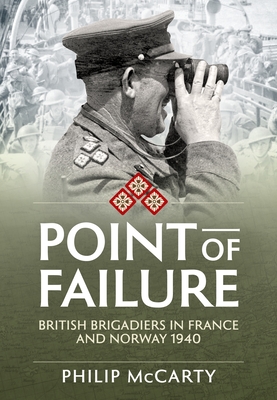
Point of Failure: British Brigadiers in France and Norway 1940
An examination of if British Army Brigadiers' survival and advancement post-1940 defeats were influenced by their pre-war backgrounds.
Point of Failure is an innovative study that examines whether or how a select group of British Army officers - Brigadiers - survived two immediate strategic defeats due to their pre-war social, professional and military backgrounds and continued to serve and advance - or not - thereafter.
By the early summer of 1940, the British Army had suffered two simultaneous operational failures in Europe, in France & Belgium from May to June and in Norway from April to May. Point of Failure considers a specific set of British Army officers, Brigadiers, who served there. In 1940, while the rank of Brigadier existed, it was more a holding rank for an officer occupying a post temporarily to fulfill a role, after which he would either revert to Colonel or be advanced to Major General. Therefore, Brigadiers were, in a sense, the Army's 'middle management' - heading for the top or making no further progress.
Point of Failure aims to examine this set of officers and to see whether their professional survival and/or advancement after 1940 was influenced by factors prevailing before it.
This is neither a study of combat effectiveness nor a campaign narrative. This would be a repetition of histories well known elsewhere. However, certain Brigadiers' performances in France brought them to the attention of senior officers. Issues such as the award of decorations and whether higher, successful commanders 'carried' their subordinate Brigadiers with them as they themselves were promoted are considered.
Factors which may have contributed to the advancement of officers, be they professional, social or operational before 1940, are addressed. Also considered are those presumed to do so, but which this book shows were either ineffectual or less influential than prior presumptions arising from the literature on the British Army in the Second World War, such as the influence of patronage by senior officers, most notably Bernard Montgomery and Alan Brooke.
By its nature, Point of Failure draws considerably on secondary sources, such as campaign narratives, biographies and biographical sources. Primary sources, such as war diaries, personal papers, and autobiographies, are used but are subject to limitations, which are discussed later. The main primary source, which would be profoundly informative on a personal level
PRP: 252.00 Lei

Acesta este Prețul Recomandat de Producător. Prețul de vânzare al produsului este afișat mai jos.
226.80Lei
226.80Lei
252.00 LeiPrimești 226 puncte

Livrare in 2-4 saptamani
Descrierea produsului
An examination of if British Army Brigadiers' survival and advancement post-1940 defeats were influenced by their pre-war backgrounds.
Point of Failure is an innovative study that examines whether or how a select group of British Army officers - Brigadiers - survived two immediate strategic defeats due to their pre-war social, professional and military backgrounds and continued to serve and advance - or not - thereafter.
By the early summer of 1940, the British Army had suffered two simultaneous operational failures in Europe, in France & Belgium from May to June and in Norway from April to May. Point of Failure considers a specific set of British Army officers, Brigadiers, who served there. In 1940, while the rank of Brigadier existed, it was more a holding rank for an officer occupying a post temporarily to fulfill a role, after which he would either revert to Colonel or be advanced to Major General. Therefore, Brigadiers were, in a sense, the Army's 'middle management' - heading for the top or making no further progress.
Point of Failure aims to examine this set of officers and to see whether their professional survival and/or advancement after 1940 was influenced by factors prevailing before it.
This is neither a study of combat effectiveness nor a campaign narrative. This would be a repetition of histories well known elsewhere. However, certain Brigadiers' performances in France brought them to the attention of senior officers. Issues such as the award of decorations and whether higher, successful commanders 'carried' their subordinate Brigadiers with them as they themselves were promoted are considered.
Factors which may have contributed to the advancement of officers, be they professional, social or operational before 1940, are addressed. Also considered are those presumed to do so, but which this book shows were either ineffectual or less influential than prior presumptions arising from the literature on the British Army in the Second World War, such as the influence of patronage by senior officers, most notably Bernard Montgomery and Alan Brooke.
By its nature, Point of Failure draws considerably on secondary sources, such as campaign narratives, biographies and biographical sources. Primary sources, such as war diaries, personal papers, and autobiographies, are used but are subject to limitations, which are discussed later. The main primary source, which would be profoundly informative on a personal level
Detaliile produsului