








Reforming to Survive: The Bolshevik Origins of Social Policies
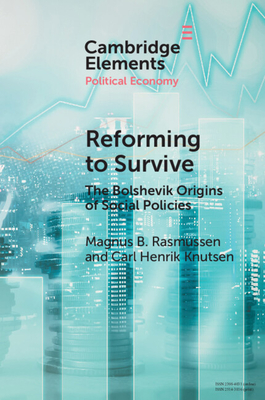
Reforming to Survive: The Bolshevik Origins of Social Policies
This Element details how elites provide policy concessions when they face credible threats of revolution. Specifically, the authors discuss how the Bolshevik Revolution of 1917 and the subsequent formation of Comintern enhanced elites' perceptions of revolutionary threat by affecting the capacity and motivation of labor movements as well as the elites' interpretation of information signals. These developments incentivized elites to provide policy concessions to urban workers, notably reduced working hours and expanded social transfer programs. The authors assess their argument by using original qualitative and quantitative data. First, they document changes in perceptions of revolutionary threat and strategic policy concessions in early inter-war Norway by using archival and other sources. Second, they code, for example, representatives at the 1919 Comintern meeting to proxy for credibility of domestic revolutionary threat in cross-national analysis. States facing greater threats expanded various social policies to a larger extent than other countries, and some of these differences persisted for decades.
PRP: 202.02 Lei

Acesta este Prețul Recomandat de Producător. Prețul de vânzare al produsului este afișat mai jos.
181.82Lei
181.82Lei
202.02 LeiPrimești 181 puncte

Indisponibil
Descrierea produsului
This Element details how elites provide policy concessions when they face credible threats of revolution. Specifically, the authors discuss how the Bolshevik Revolution of 1917 and the subsequent formation of Comintern enhanced elites' perceptions of revolutionary threat by affecting the capacity and motivation of labor movements as well as the elites' interpretation of information signals. These developments incentivized elites to provide policy concessions to urban workers, notably reduced working hours and expanded social transfer programs. The authors assess their argument by using original qualitative and quantitative data. First, they document changes in perceptions of revolutionary threat and strategic policy concessions in early inter-war Norway by using archival and other sources. Second, they code, for example, representatives at the 1919 Comintern meeting to proxy for credibility of domestic revolutionary threat in cross-national analysis. States facing greater threats expanded various social policies to a larger extent than other countries, and some of these differences persisted for decades.
Detaliile produsului




