


- /
- Librarie online
- /
- Carti in engleza
- /
- Education
- /
- Multicultural Education
- /
- Teaching Intercultural Citizenship Across the Curriculum - Manuela Wagner
Teaching Intercultural Citizenship Across the Curriculum
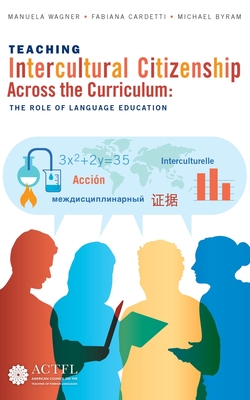
Teaching Intercultural Citizenship Across the Curriculum
Manuela Wagner, an applied linguist, began her career studying how infants and children learn to communicate. Always loving to learn new languages and observe different cultures, she started teaching English in Austria and Germany, followed by Spanish and German in K-12 and at the university in the U.S., while completing her Ph.D. in English with a focus on linguistics at Graz University, Austria. Fostered by her interdisciplinary education (English department in Austria, Max-Planck-Institute for Brain Research in German, and the Harvard Graduate School of Education) her true passion is collaborating with colleagues from different disciplines and in diverse educational settings to investigate difficult questions related to the use of theory and practice. At the University of Connecticut she was hired through the Teachers for a New Era grant, which supported the ideals of interdisciplinarity and of conducting research into how to help all students succeed. For her that entails making education relevant for all students and in their lives in the here and now. Fabiana Cardetti, a research mathematician who became a university professor, loves to help others understand the intricacies, logic, and beauty of mathematics. This passion for teaching was inspired by her father and other extraordinary teachers and colleagues. Soon after joining the faculty at the University of Connecticut, she supported the mathematical education of in-service and pre-service teachers, which prompted a significant change in her research career. While she thoroughly enjoyed tinkering with the theories of geometric control theory, she progressively shifted her focus to fully dedicate to research in mathematics education. She has continued and extended this work in collaboration with colleagues from different disciplines and in active partnership with teachers at different educational levels, aiming to empower all students in their lives and, hopefully, their futures. Michael (Mike) Byram began as a teacher of languages in an English secondary school, a ' community comprehensive, ' and taught French and German to adolescents in the daytime and adults of all ages in the evening. This became the basis for his research on what he originally called ' cultural studies in foreign language education, ' unconsciously using the phrase he had learned from a key intellectual influence, Raymond Williams. He wanted to find ways to consider the cultural dimension of language teaching. In time he created a model of intercultural (communicative) competence in Teaching and Assessing Intercultural Communicative Competence (1997), which could be used to systematically plan a cultural dimension and integrate it with language learning. This included the element of ' critical cultural awareness, ' the crucial educational feature of the 1997 model, which then became a model of ' Intercultural Citizenship, ' introduced in 2008 in From Foreign Language Education to Education for Intercultural Citizenship.
PRP: 268.38 Lei

Acesta este Prețul Recomandat de Producător. Prețul de vânzare al produsului este afișat mai jos.
241.54Lei
241.54Lei
268.38 LeiPrimești 241 puncte

Livrare in 2-4 saptamani
Descrierea produsului
Manuela Wagner, an applied linguist, began her career studying how infants and children learn to communicate. Always loving to learn new languages and observe different cultures, she started teaching English in Austria and Germany, followed by Spanish and German in K-12 and at the university in the U.S., while completing her Ph.D. in English with a focus on linguistics at Graz University, Austria. Fostered by her interdisciplinary education (English department in Austria, Max-Planck-Institute for Brain Research in German, and the Harvard Graduate School of Education) her true passion is collaborating with colleagues from different disciplines and in diverse educational settings to investigate difficult questions related to the use of theory and practice. At the University of Connecticut she was hired through the Teachers for a New Era grant, which supported the ideals of interdisciplinarity and of conducting research into how to help all students succeed. For her that entails making education relevant for all students and in their lives in the here and now. Fabiana Cardetti, a research mathematician who became a university professor, loves to help others understand the intricacies, logic, and beauty of mathematics. This passion for teaching was inspired by her father and other extraordinary teachers and colleagues. Soon after joining the faculty at the University of Connecticut, she supported the mathematical education of in-service and pre-service teachers, which prompted a significant change in her research career. While she thoroughly enjoyed tinkering with the theories of geometric control theory, she progressively shifted her focus to fully dedicate to research in mathematics education. She has continued and extended this work in collaboration with colleagues from different disciplines and in active partnership with teachers at different educational levels, aiming to empower all students in their lives and, hopefully, their futures. Michael (Mike) Byram began as a teacher of languages in an English secondary school, a ' community comprehensive, ' and taught French and German to adolescents in the daytime and adults of all ages in the evening. This became the basis for his research on what he originally called ' cultural studies in foreign language education, ' unconsciously using the phrase he had learned from a key intellectual influence, Raymond Williams. He wanted to find ways to consider the cultural dimension of language teaching. In time he created a model of intercultural (communicative) competence in Teaching and Assessing Intercultural Communicative Competence (1997), which could be used to systematically plan a cultural dimension and integrate it with language learning. This included the element of ' critical cultural awareness, ' the crucial educational feature of the 1997 model, which then became a model of ' Intercultural Citizenship, ' introduced in 2008 in From Foreign Language Education to Education for Intercultural Citizenship.
Detaliile produsului