



- /
- Librarie online
- /
- Carti in engleza
- /
- Mathematics
- /
- Geometry
- /
- Analytic
- /
- The Golden Ratio: The Facts and the Myths - Francis D. Hauser Phd
The Golden Ratio: The Facts and the Myths
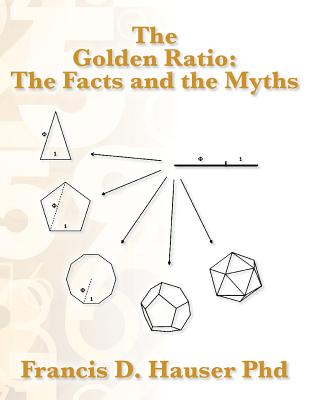
Euclid's masterpiece textbook, The Elements, was written twenty-three hundred years ago. It is primarily about geometry and contains dozens of figures. Five of these are constructed using a line that "is cut in extreme and mean ratio." Today this is called the golden ratio and is often referred to by the symbol Φ.
Many myths have grown up around this ratio. This book was written to learn about them. They arise from the pyramids, the Pythagorean Brotherhood, the platonic solids, the Fibonacci numbers, sea shells, and others. There is a common thread among these myths. Φ is an irrational number (a number whose digits after the decimal point go on forever and never form a repeating pattern). Φ can be used to draw pleasing figures. But its numerical value cannot be written down using integers and fractions, which were the only numbers used in Euclid's time.
Mathematicians before Euclid knew that irrational numbers existed. But to many people, a number that can't be written down was absurd. For centuries, many scientists and engineers believed that Φ was godlike.
This book discusses the myths from an engineering viewpoint. The last chapter of the book shows how Euclid handled irrational numbers; how Euclid did algebra using geometry; and a simple visual proof of why there are only five platonic solids.PRP: 100.36 Lei

Acesta este Prețul Recomandat de Producător. Prețul de vânzare al produsului este afișat mai jos.
90.32Lei
90.32Lei
100.36 LeiPrimești 90 puncte

Livrare in 2-4 saptamani
Descrierea produsului
Euclid's masterpiece textbook, The Elements, was written twenty-three hundred years ago. It is primarily about geometry and contains dozens of figures. Five of these are constructed using a line that "is cut in extreme and mean ratio." Today this is called the golden ratio and is often referred to by the symbol Φ.
Many myths have grown up around this ratio. This book was written to learn about them. They arise from the pyramids, the Pythagorean Brotherhood, the platonic solids, the Fibonacci numbers, sea shells, and others. There is a common thread among these myths. Φ is an irrational number (a number whose digits after the decimal point go on forever and never form a repeating pattern). Φ can be used to draw pleasing figures. But its numerical value cannot be written down using integers and fractions, which were the only numbers used in Euclid's time.
Mathematicians before Euclid knew that irrational numbers existed. But to many people, a number that can't be written down was absurd. For centuries, many scientists and engineers believed that Φ was godlike.
This book discusses the myths from an engineering viewpoint. The last chapter of the book shows how Euclid handled irrational numbers; how Euclid did algebra using geometry; and a simple visual proof of why there are only five platonic solids.Detaliile produsului