







The Material Culture of English Rural Households c.1250-1600
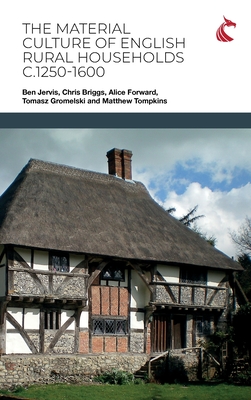
The Material Culture of English Rural Households c.1250-1600
This book presents a synthesis and analysis of the possessions of non-elite rural households in medieval England. Drawing on the results of the Leverhulme Trust funded project 'Living Standards and Material Culture in English Rural Households, 1300-1600', it represents the first national-scale interdisciplinary analysis of non-elite consumption in the later Middle Ages. The research is situated within debates around rising living standards in the period following the Black Death, the commercialisation of the English economy and the timing of a 'revolution' in consumer behaviour. Its novelty derives from its focus on non-elite rural households. Whilst there has been considerable work on the possessions of the great households and those living in larger towns, researchers have struggled to identify appropriate sources for understanding the possessions of those living in the countryside, even though they account for the majority of England's population at this time. This book will address the gap in understanding.
The study combines 3 sources of data to address 2 questions: what goods did medieval households own, and what influenced their consumption habits? The first is archaeological evidence, comprising 14,706 objects recovered from archaeological excavations. The book synthesises this data, much of which is unpublished and therefore inaccessible to researchers. The second dataset derives from lists of the seized goods of felons, outlaws and suicides collated by the Escheator, a royal official, in the 14th and 15th centuries. The work of the Escheator is not well understood, but these lists, relating to some of the poorest people in medieval society (for whom traditional sources such as wills and probate inventories do not exist), provide new insights into the living standards of rural households. The lists typically detail and value the possessions of a household, meaning that it is possible to present a quantitative analysis of non-elite consumption for the first time. The final dataset draws on equivalent lists generated by the Coroner for the 16th century. An interdisciplinary approach is essential, as many objects identified archaeologically do not occur in the written records, and goods such as textiles do not survive in the ground. Drawing these sources together therefore allows the presentation of a more comprehensive analysis of the possessions of medieval households.
The introduction lays out the research context in a manner accessible
The study combines 3 sources of data to address 2 questions: what goods did medieval households own, and what influenced their consumption habits? The first is archaeological evidence, comprising 14,706 objects recovered from archaeological excavations. The book synthesises this data, much of which is unpublished and therefore inaccessible to researchers. The second dataset derives from lists of the seized goods of felons, outlaws and suicides collated by the Escheator, a royal official, in the 14th and 15th centuries. The work of the Escheator is not well understood, but these lists, relating to some of the poorest people in medieval society (for whom traditional sources such as wills and probate inventories do not exist), provide new insights into the living standards of rural households. The lists typically detail and value the possessions of a household, meaning that it is possible to present a quantitative analysis of non-elite consumption for the first time. The final dataset draws on equivalent lists generated by the Coroner for the 16th century. An interdisciplinary approach is essential, as many objects identified archaeologically do not occur in the written records, and goods such as textiles do not survive in the ground. Drawing these sources together therefore allows the presentation of a more comprehensive analysis of the possessions of medieval households.
The introduction lays out the research context in a manner accessible
PRP: 661.25 Lei

Acesta este Prețul Recomandat de Producător. Prețul de vânzare al produsului este afișat mai jos.
595.12Lei
595.12Lei
661.25 LeiPrimești 595 puncte

Indisponibil
Descrierea produsului
This book presents a synthesis and analysis of the possessions of non-elite rural households in medieval England. Drawing on the results of the Leverhulme Trust funded project 'Living Standards and Material Culture in English Rural Households, 1300-1600', it represents the first national-scale interdisciplinary analysis of non-elite consumption in the later Middle Ages. The research is situated within debates around rising living standards in the period following the Black Death, the commercialisation of the English economy and the timing of a 'revolution' in consumer behaviour. Its novelty derives from its focus on non-elite rural households. Whilst there has been considerable work on the possessions of the great households and those living in larger towns, researchers have struggled to identify appropriate sources for understanding the possessions of those living in the countryside, even though they account for the majority of England's population at this time. This book will address the gap in understanding.
The study combines 3 sources of data to address 2 questions: what goods did medieval households own, and what influenced their consumption habits? The first is archaeological evidence, comprising 14,706 objects recovered from archaeological excavations. The book synthesises this data, much of which is unpublished and therefore inaccessible to researchers. The second dataset derives from lists of the seized goods of felons, outlaws and suicides collated by the Escheator, a royal official, in the 14th and 15th centuries. The work of the Escheator is not well understood, but these lists, relating to some of the poorest people in medieval society (for whom traditional sources such as wills and probate inventories do not exist), provide new insights into the living standards of rural households. The lists typically detail and value the possessions of a household, meaning that it is possible to present a quantitative analysis of non-elite consumption for the first time. The final dataset draws on equivalent lists generated by the Coroner for the 16th century. An interdisciplinary approach is essential, as many objects identified archaeologically do not occur in the written records, and goods such as textiles do not survive in the ground. Drawing these sources together therefore allows the presentation of a more comprehensive analysis of the possessions of medieval households.
The introduction lays out the research context in a manner accessible
The study combines 3 sources of data to address 2 questions: what goods did medieval households own, and what influenced their consumption habits? The first is archaeological evidence, comprising 14,706 objects recovered from archaeological excavations. The book synthesises this data, much of which is unpublished and therefore inaccessible to researchers. The second dataset derives from lists of the seized goods of felons, outlaws and suicides collated by the Escheator, a royal official, in the 14th and 15th centuries. The work of the Escheator is not well understood, but these lists, relating to some of the poorest people in medieval society (for whom traditional sources such as wills and probate inventories do not exist), provide new insights into the living standards of rural households. The lists typically detail and value the possessions of a household, meaning that it is possible to present a quantitative analysis of non-elite consumption for the first time. The final dataset draws on equivalent lists generated by the Coroner for the 16th century. An interdisciplinary approach is essential, as many objects identified archaeologically do not occur in the written records, and goods such as textiles do not survive in the ground. Drawing these sources together therefore allows the presentation of a more comprehensive analysis of the possessions of medieval households.
The introduction lays out the research context in a manner accessible
Detaliile produsului