



- /
- Librarie online
- /
- Carti in engleza
- /
- History
- /
- United States
- /
- State & Local
- /
- South (al, Ar, Fl, Ga, Ky, La, Ms, Nc, Sc, Tn, Va, Wv)
- /
- Uncivil War: Five New Orleans Street Battles and the Rise and Fall of Radical Reconstruction - James K. Hogue
Uncivil War: Five New Orleans Street Battles and the Rise and Fall of Radical Reconstruction
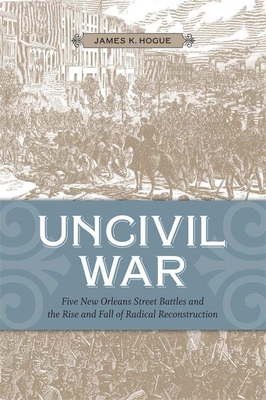
No other Reconstruction state government was as chaotic or violent as Louisiana's, located in New Orleans, the largest southern city at the time. James K. Hogue explains the unique confluence of demographics, geography, and wartime events that made New Orleans an epicenter in the upheaval of Reconstruction politics and a critical battleground in the struggle for the future of southern society. No other Reconstruction state government was as chaotic or violent as Louisiana's, located in New Orleans, the largest southern city at the time. James K. Hogue explains the unique confluence of demographics, geography, and wartime events that made New Orleans an epicenter in the upheaval of Reconstruction politics and a critical battleground in the struggle for the future of southern society.
Hogue characterizes Reconstruction in Louisiana as a continuation of civil war, waged between well-organized and well-armed forces vying to control the state's government. He details five key New Orleans street battles, in which elite Confederate veterans played central roles, and gives an in-depth account of how the Republican state government raised militias and a state police force to defend against the violence. In response, a white supremacist movement arose in the mid-1870s and finally overthrew the Republicans. The occupation of Louisiana by federal troops from 1862 to 1877 was the longest of its kind in American history. Not coincidentally, Hogue argues, one of the longest unbroken periods of one-race, one-party dominance in American history followed, lasting until 1972.
Uncivil War reveals that the long-term military impact of the South's occupation included twenty-five years of crippled War Department budgets inflicted by southern congressmen who feared another Reconstruction. Within Louisiana, the biracial Republican militias were dismantled, leaving blacks largely unarmed against future atrocities; at the same time, the nucleus of the state's White Leagues became the Louisiana National Guard, which defended the "Redeemer" government's repressive labor policies. White supremacist victory cast its shadow over American race relations for almost a century.
Moving between national, state, and local realms, Uncivil War demystifies the interplay of force and politics during a complex period of American history.
PRP: 306.90 Lei

Acesta este Prețul Recomandat de Producător. Prețul de vânzare al produsului este afișat mai jos.
276.21Lei
276.21Lei
306.90 LeiPrimești 276 puncte

Livrare in 2-4 saptamani
Descrierea produsului
No other Reconstruction state government was as chaotic or violent as Louisiana's, located in New Orleans, the largest southern city at the time. James K. Hogue explains the unique confluence of demographics, geography, and wartime events that made New Orleans an epicenter in the upheaval of Reconstruction politics and a critical battleground in the struggle for the future of southern society. No other Reconstruction state government was as chaotic or violent as Louisiana's, located in New Orleans, the largest southern city at the time. James K. Hogue explains the unique confluence of demographics, geography, and wartime events that made New Orleans an epicenter in the upheaval of Reconstruction politics and a critical battleground in the struggle for the future of southern society.
Hogue characterizes Reconstruction in Louisiana as a continuation of civil war, waged between well-organized and well-armed forces vying to control the state's government. He details five key New Orleans street battles, in which elite Confederate veterans played central roles, and gives an in-depth account of how the Republican state government raised militias and a state police force to defend against the violence. In response, a white supremacist movement arose in the mid-1870s and finally overthrew the Republicans. The occupation of Louisiana by federal troops from 1862 to 1877 was the longest of its kind in American history. Not coincidentally, Hogue argues, one of the longest unbroken periods of one-race, one-party dominance in American history followed, lasting until 1972.
Uncivil War reveals that the long-term military impact of the South's occupation included twenty-five years of crippled War Department budgets inflicted by southern congressmen who feared another Reconstruction. Within Louisiana, the biracial Republican militias were dismantled, leaving blacks largely unarmed against future atrocities; at the same time, the nucleus of the state's White Leagues became the Louisiana National Guard, which defended the "Redeemer" government's repressive labor policies. White supremacist victory cast its shadow over American race relations for almost a century.
Moving between national, state, and local realms, Uncivil War demystifies the interplay of force and politics during a complex period of American history.
Detaliile produsului