







- /
- Librarie online
- /
- Carti in engleza
- /
- Nature
- /
- Ecology
- /
- Vital Reenchantments: Biophilia, Gaia, Cosmos, and the Affectively Ecological - Lauren Greyson
Vital Reenchantments: Biophilia, Gaia, Cosmos, and the Affectively Ecological
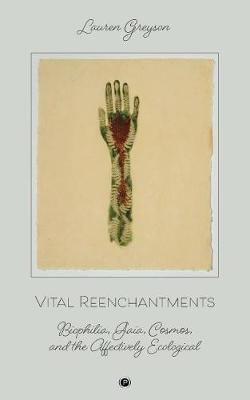
Vital Reenchantments: Biophilia, Gaia, Cosmos, and the Affectively Ecological
Not all charms fly at the touch of cold philosophy. Vital Reenchantments examines so-called cold philosophy, or science, that does precisely the opposite - rather than mercilessly emptying out and unweaving, it operates as a philosophy that animates. More specifically, Greyson closely examines how a specific group of "poet-in-scientists" of the late 1970s and 1980s directed attention to the "wondrous" unfolding of life, at a time when the counter-culture in particular had made the institution of science synonymous with technologies of alienation and destruction.In this vein, Vital Reenchantments takes up E.O. Wilson's Biophilia (1984), James Lovelock's Gaia (1979), and Carl Sagan's Cosmos (1980), in order to show how each work fleshes out scientific concepts with a unique attention to "affective wonder," understood as the experience of and attunement to novel effects. What is so unique about these works is that they reenchant the scientific world without pandering to what Richard Dawkins will later term "cosmic sentimentality." Carl Sagan may have said "We are made of starstuff," but he would never insist, as Joni Mitchell did in 1969, that "we've got to get ourselves back to the garden." Instead, they insist on a third way that does not rely on the idea of an ecological Eden - a vigorously vital materialism in which the affective trumps the sentimental. Further, the historical emergence of these works, all published within 5 years of each other, was no accident: each book responded to an ever deepening sense of environmental crisis, certainly, but along with it they responded to, perhaps more than marginally related, narratives of the large-scale disenchantment brought on by modernity or science, and more often than not a mixture of the two. Greyson argues that the persistence of these works and their affectively-charged scientific concepts in contemporary popular culture and ecological thought is no accident. As such, these works deserve recognition as far more than "popular science" and can be seen as essential contributions to more contemporary vital materialist thought and ecological theory.No doubt this talk of enchantment and wonder, so tied to immediate experience, can seem trivial in the face of any number of environmental crises (global warming first among these) that do not just appear ominously on the horizon, but loom as never before. The first task of this book thus to pose the same question that Jane Bennett does at the end of her own wo
PRP: 193.75 Lei

Acesta este Prețul Recomandat de Producător. Prețul de vânzare al produsului este afișat mai jos.
174.38Lei
174.38Lei
193.75 LeiPrimești 174 puncte

Livrare in 2-4 saptamani
Descrierea produsului
Not all charms fly at the touch of cold philosophy. Vital Reenchantments examines so-called cold philosophy, or science, that does precisely the opposite - rather than mercilessly emptying out and unweaving, it operates as a philosophy that animates. More specifically, Greyson closely examines how a specific group of "poet-in-scientists" of the late 1970s and 1980s directed attention to the "wondrous" unfolding of life, at a time when the counter-culture in particular had made the institution of science synonymous with technologies of alienation and destruction.In this vein, Vital Reenchantments takes up E.O. Wilson's Biophilia (1984), James Lovelock's Gaia (1979), and Carl Sagan's Cosmos (1980), in order to show how each work fleshes out scientific concepts with a unique attention to "affective wonder," understood as the experience of and attunement to novel effects. What is so unique about these works is that they reenchant the scientific world without pandering to what Richard Dawkins will later term "cosmic sentimentality." Carl Sagan may have said "We are made of starstuff," but he would never insist, as Joni Mitchell did in 1969, that "we've got to get ourselves back to the garden." Instead, they insist on a third way that does not rely on the idea of an ecological Eden - a vigorously vital materialism in which the affective trumps the sentimental. Further, the historical emergence of these works, all published within 5 years of each other, was no accident: each book responded to an ever deepening sense of environmental crisis, certainly, but along with it they responded to, perhaps more than marginally related, narratives of the large-scale disenchantment brought on by modernity or science, and more often than not a mixture of the two. Greyson argues that the persistence of these works and their affectively-charged scientific concepts in contemporary popular culture and ecological thought is no accident. As such, these works deserve recognition as far more than "popular science" and can be seen as essential contributions to more contemporary vital materialist thought and ecological theory.No doubt this talk of enchantment and wonder, so tied to immediate experience, can seem trivial in the face of any number of environmental crises (global warming first among these) that do not just appear ominously on the horizon, but loom as never before. The first task of this book thus to pose the same question that Jane Bennett does at the end of her own wo
Detaliile produsului