



- /
- Librarie online
- /
- Carti in engleza
- /
- Language Arts & Disciplines
- /
- Linguistics
- /
- Sociolinguistics
- /
- What Proust Heard: Novels and the Ethnography of Talk - Michael Lucey
What Proust Heard: Novels and the Ethnography of Talk
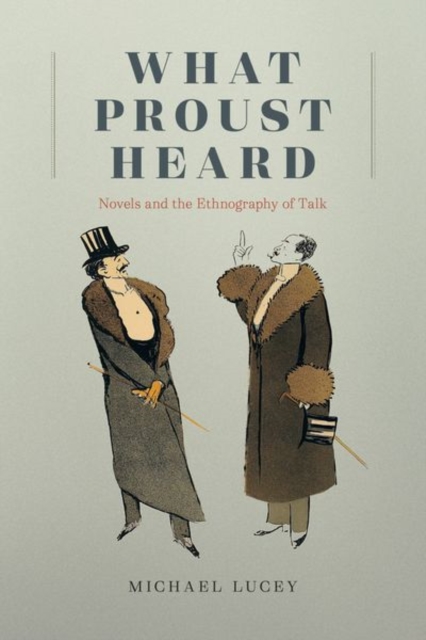
What Proust Heard: Novels and the Ethnography of Talk
Michael Lucey offers a linguistic anthropological analysis of Proust's In Search of Lost Time. What happens when we talk? This deceptively simple question is central to Marcel Proust's monumental novel In Search of Lost Time. Both Proust's narrator and the novel that houses him devote considerable energy to investigating not just what people are saying or doing when they talk, but also what happens socioculturally through their use of language. Proust, in other words, is interested in what linguistic anthropologists call language-in-use. Michael Lucey elucidates Proust's approach to language-in-use in a number of ways: principally in relation to linguistic anthropology, but also in relation to speech act theory, and to Pierre Bourdieu's sociology. The book also includes an interlude after each of its chapters that contextualizes Proust's social-scientific practice of novel writing in relation to that of a number of other novelists, earlier and later, and from several different traditions, including Honoré de Balzac, George Eliot, Virginia Woolf, Nathalie Sarraute, and Rachel Cusk. Lucey is thus able to show how, in the hands of quite different novelists, various aspects of the novel form become instruments of linguistic anthropological analysis. The result introduces a different way of understanding language to literary and cultural critics and explores the consequences of this new understanding for the practice of literary criticism more generally.
PRP: 651.00 Lei

Acesta este Prețul Recomandat de Producător. Prețul de vânzare al produsului este afișat mai jos.
520.80Lei
520.80Lei
651.00 LeiPrimești 520 puncte

Livrare in 2-4 saptamani
Descrierea produsului
Michael Lucey offers a linguistic anthropological analysis of Proust's In Search of Lost Time. What happens when we talk? This deceptively simple question is central to Marcel Proust's monumental novel In Search of Lost Time. Both Proust's narrator and the novel that houses him devote considerable energy to investigating not just what people are saying or doing when they talk, but also what happens socioculturally through their use of language. Proust, in other words, is interested in what linguistic anthropologists call language-in-use. Michael Lucey elucidates Proust's approach to language-in-use in a number of ways: principally in relation to linguistic anthropology, but also in relation to speech act theory, and to Pierre Bourdieu's sociology. The book also includes an interlude after each of its chapters that contextualizes Proust's social-scientific practice of novel writing in relation to that of a number of other novelists, earlier and later, and from several different traditions, including Honoré de Balzac, George Eliot, Virginia Woolf, Nathalie Sarraute, and Rachel Cusk. Lucey is thus able to show how, in the hands of quite different novelists, various aspects of the novel form become instruments of linguistic anthropological analysis. The result introduces a different way of understanding language to literary and cultural critics and explores the consequences of this new understanding for the practice of literary criticism more generally.
Detaliile produsului