







Comet Madness: How the 1910 Return of Halley's Comet (Almost) Destroyed Civilization
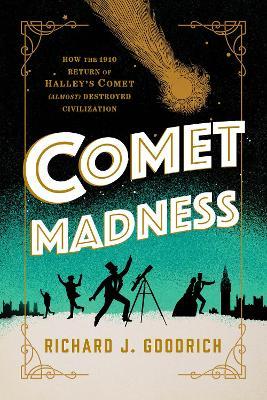
Comet Madness: How the 1910 Return of Halley's Comet (Almost) Destroyed Civilization
Halley's Comet visits the earth every seventy-five years. Since the dawn of civilization, humans had believed comets were evil portents. In 1705, Edmond Halley liberated humanity from these primordial superstitions (or so it was thought), proving that Newtonian mechanics rather than the will of the gods brought comets into our celestial neighborhood. Despite this scientific advance, when Halley's Comet returned in 1910 and astronomers announced that our planet would pass through its poisonous tail, newspapers gleefully provoked a global hysteria that unfolded with tragic consequences. In Comet Madness, author and historian Richard J. Goodrich examines the 1910 appearance of Halley's Comet and the ensuing frenzy sparked by media manipulation, bogus science, and outright deception. The result is a fascinating and illuminating narrative history that underscores how we behave in the face of potential calamity - then and now. As the comet neared Earth, scientists and journalists alike scrambled to get the story straight as citizens the world over panicked. Popular astronomer Camille Flammarion attempted to allay fears in a newspaper article, but the media ignored his true position that passage would be harmless; weather prophet Irl Hicks, publisher of an annual, pseudo-scientific almanac, announced that the comet would disrupt the world's weather; religious leaders thumbed the Bible's Book of Revelation and wondered if the comet presaged the apocalypse. Newspapers, confident that there was gold in these alternate theories, gave every crackpot a megaphone, increasing circulation and stoking international hysteria. As a result, workmen shelved their tools, farmers refused to plant crops they would never harvest, and formerly reliable people stopped paying their creditors. More opportunistic citizens opened "comet insurance" plans. Others suffered mental breakdowns, and some took their own lives. Comet Madness reveals how humans confront the unknown, how scientists learn about the world we inhabit, and how certain people--from outright hucksters to opportunistic journalists--harness fear to produce a profit.
PRP: 147.26 Lei

Acesta este Prețul Recomandat de Producător. Prețul de vânzare al produsului este afișat mai jos.
132.53Lei
132.53Lei
147.26 LeiPrimești 132 puncte
Indisponibil
Descrierea produsului
Halley's Comet visits the earth every seventy-five years. Since the dawn of civilization, humans had believed comets were evil portents. In 1705, Edmond Halley liberated humanity from these primordial superstitions (or so it was thought), proving that Newtonian mechanics rather than the will of the gods brought comets into our celestial neighborhood. Despite this scientific advance, when Halley's Comet returned in 1910 and astronomers announced that our planet would pass through its poisonous tail, newspapers gleefully provoked a global hysteria that unfolded with tragic consequences. In Comet Madness, author and historian Richard J. Goodrich examines the 1910 appearance of Halley's Comet and the ensuing frenzy sparked by media manipulation, bogus science, and outright deception. The result is a fascinating and illuminating narrative history that underscores how we behave in the face of potential calamity - then and now. As the comet neared Earth, scientists and journalists alike scrambled to get the story straight as citizens the world over panicked. Popular astronomer Camille Flammarion attempted to allay fears in a newspaper article, but the media ignored his true position that passage would be harmless; weather prophet Irl Hicks, publisher of an annual, pseudo-scientific almanac, announced that the comet would disrupt the world's weather; religious leaders thumbed the Bible's Book of Revelation and wondered if the comet presaged the apocalypse. Newspapers, confident that there was gold in these alternate theories, gave every crackpot a megaphone, increasing circulation and stoking international hysteria. As a result, workmen shelved their tools, farmers refused to plant crops they would never harvest, and formerly reliable people stopped paying their creditors. More opportunistic citizens opened "comet insurance" plans. Others suffered mental breakdowns, and some took their own lives. Comet Madness reveals how humans confront the unknown, how scientists learn about the world we inhabit, and how certain people--from outright hucksters to opportunistic journalists--harness fear to produce a profit.
Detaliile produsului



