







Critic as Artist
Critic as Artist
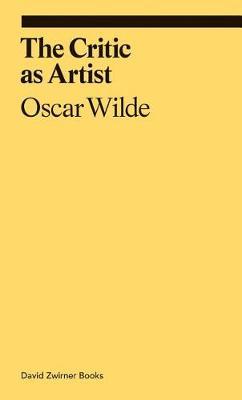
In The Critic as Artist--arguably the most complete exploration of his aesthetic thinking, and certainly the most entertaining--Oscar Wilde harnesses his famous wit to demolish the supposed boundary between art and criticism.
Subtitled Upon the Importance of Doing Nothing and Discussing Everything, the essay takes the form of a leisurely dialogue between two characters: Ernest, who insists upon Wilde's own belief in art's freedom from societal mandates and values, and a quizzical Gilbert. With his playwright's ear for dialogue, Wilde champions idleness and contemplation as prerequisites to artistic cultivation. Beyond the well-known dictum of art for art's sake, Wilde's originality lays an argument for the equality of criticism and art. For him, criticism is not subject to the work of art, but can in fact precede it: the artist cannot create without engaging his or her critical faculties first. And, as Wilde writes, "To the critic the work of art is simply a suggestion for a new work of his own."
The field of art and criticism should be open to the free play of the mind, but Wilde plays seriously, even prophetically. Writing in 1891, he foresaw that criticism would have an increasingly important role as the need to make sense of what we see increases with the complexities of modern life. It is only the fine perception and explication of beauty, Wilde suggests, that will allow us to create meaning, joy, empathy and peace out of the chaos of facts and reality.
Oscar Wilde (1854-1900) was an Irish poet and playwright who became one of London's most popular writers in the early 1890s. Though often controversial, his flair for journalism and nose for scandal ensured that he was widely read. His bold essays on aesthetic philosophy, collected in the volume Intentions (1891), remain important and influential meditations of the nature of art criticism itself.
Subtitled Upon the Importance of Doing Nothing and Discussing Everything, the essay takes the form of a leisurely dialogue between two characters: Ernest, who insists upon Wilde's own belief in art's freedom from societal mandates and values, and a quizzical Gilbert. With his playwright's ear for dialogue, Wilde champions idleness and contemplation as prerequisites to artistic cultivation. Beyond the well-known dictum of art for art's sake, Wilde's originality lays an argument for the equality of criticism and art. For him, criticism is not subject to the work of art, but can in fact precede it: the artist cannot create without engaging his or her critical faculties first. And, as Wilde writes, "To the critic the work of art is simply a suggestion for a new work of his own."
The field of art and criticism should be open to the free play of the mind, but Wilde plays seriously, even prophetically. Writing in 1891, he foresaw that criticism would have an increasingly important role as the need to make sense of what we see increases with the complexities of modern life. It is only the fine perception and explication of beauty, Wilde suggests, that will allow us to create meaning, joy, empathy and peace out of the chaos of facts and reality.
Oscar Wilde (1854-1900) was an Irish poet and playwright who became one of London's most popular writers in the early 1890s. Though often controversial, his flair for journalism and nose for scandal ensured that he was widely read. His bold essays on aesthetic philosophy, collected in the volume Intentions (1891), remain important and influential meditations of the nature of art criticism itself.
PRP: 86.40 Lei

Acesta este Prețul Recomandat de Producător. Prețul de vânzare al produsului este afișat mai jos.
77.76Lei
77.76Lei
86.40 LeiPrimești 77 puncte

Indisponibil
Descrierea produsului
In The Critic as Artist--arguably the most complete exploration of his aesthetic thinking, and certainly the most entertaining--Oscar Wilde harnesses his famous wit to demolish the supposed boundary between art and criticism.
Subtitled Upon the Importance of Doing Nothing and Discussing Everything, the essay takes the form of a leisurely dialogue between two characters: Ernest, who insists upon Wilde's own belief in art's freedom from societal mandates and values, and a quizzical Gilbert. With his playwright's ear for dialogue, Wilde champions idleness and contemplation as prerequisites to artistic cultivation. Beyond the well-known dictum of art for art's sake, Wilde's originality lays an argument for the equality of criticism and art. For him, criticism is not subject to the work of art, but can in fact precede it: the artist cannot create without engaging his or her critical faculties first. And, as Wilde writes, "To the critic the work of art is simply a suggestion for a new work of his own."
The field of art and criticism should be open to the free play of the mind, but Wilde plays seriously, even prophetically. Writing in 1891, he foresaw that criticism would have an increasingly important role as the need to make sense of what we see increases with the complexities of modern life. It is only the fine perception and explication of beauty, Wilde suggests, that will allow us to create meaning, joy, empathy and peace out of the chaos of facts and reality.
Oscar Wilde (1854-1900) was an Irish poet and playwright who became one of London's most popular writers in the early 1890s. Though often controversial, his flair for journalism and nose for scandal ensured that he was widely read. His bold essays on aesthetic philosophy, collected in the volume Intentions (1891), remain important and influential meditations of the nature of art criticism itself.
Subtitled Upon the Importance of Doing Nothing and Discussing Everything, the essay takes the form of a leisurely dialogue between two characters: Ernest, who insists upon Wilde's own belief in art's freedom from societal mandates and values, and a quizzical Gilbert. With his playwright's ear for dialogue, Wilde champions idleness and contemplation as prerequisites to artistic cultivation. Beyond the well-known dictum of art for art's sake, Wilde's originality lays an argument for the equality of criticism and art. For him, criticism is not subject to the work of art, but can in fact precede it: the artist cannot create without engaging his or her critical faculties first. And, as Wilde writes, "To the critic the work of art is simply a suggestion for a new work of his own."
The field of art and criticism should be open to the free play of the mind, but Wilde plays seriously, even prophetically. Writing in 1891, he foresaw that criticism would have an increasingly important role as the need to make sense of what we see increases with the complexities of modern life. It is only the fine perception and explication of beauty, Wilde suggests, that will allow us to create meaning, joy, empathy and peace out of the chaos of facts and reality.
Oscar Wilde (1854-1900) was an Irish poet and playwright who became one of London's most popular writers in the early 1890s. Though often controversial, his flair for journalism and nose for scandal ensured that he was widely read. His bold essays on aesthetic philosophy, collected in the volume Intentions (1891), remain important and influential meditations of the nature of art criticism itself.
Detaliile produsului