



- /
- Librarie online
- /
- Carti in engleza
- /
- Education
- /
- Bilingual Education
- /
- Education for Extinction: American Indians and the Boarding School Experience, 1875-1928 - David Wallace Adams
Education for Extinction: American Indians and the Boarding School Experience, 1875-1928
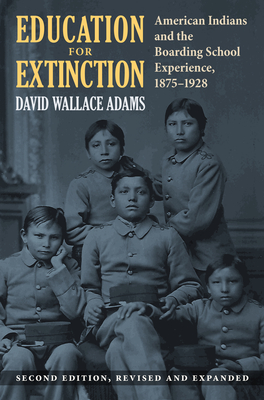
Education for Extinction: American Indians and the Boarding School Experience, 1875-1928
The last "Indian War" was fought against Native American children in the dormitories and classrooms of government boarding schools. Only by removing Indian children from their homes for extended periods of time, policymakers reasoned, could white "civilization" take root while childhood memories of "savagism" gradually faded to the point of extinction. In the words of one official: "Kill the Indian and save the man." This fully revised edition of Education for Extinction offers the only comprehensive account of this dispiriting effort, and incorporates the last twenty-five years of scholarship. Much more than a study of federal Indian policy, this book vividly details the day-to-day experiences of Indian youth living in a "total institution" designed to reconstruct them both psychologically and culturally. The assault on identity came in many forms: the shearing off of braids, the assignment of new names, uniformed drill routines, humiliating punishments, relentless attacks on native religious beliefs, patriotic indoctrinations, suppression of tribal languages, Victorian gender rituals, football contests, and industrial training. Especially poignant is Adams's description of the ways in which students resisted or accommodated themselves to forced assimilation. Many converted to varying degrees, but others plotted escapes, committed arson, and devised ingenious strategies of passive resistance. Adams also argues that many of those who seemingly cooperated with the system were more than passive players in this drama, that the response of accommodation was not synonymous with cultural surrender. This is especially apparent in his analysis of students who returned to the reservation. He reveals the various ways in which graduates struggled to make sense of their lives and selectively drew upon their school experience in negotiating personal and tribal survival in a world increasingly dominated by white men. The discussion comes full circle when Adams reviews the government's gradual retreat from the assimilationist vision. Partly because of persistent student resistance, but also partly because of a complex and sometimes contradictory set of progressive, humanitarian, and racist motivations, policymakers did eventually come to view boarding schools less enthusiastically. Based upon extensive use of government archives, Indian and teacher autobiographies, and school newspapers, Adams's moving account is essential reading for scholars and general readers ali
PRP: 336.09 Lei

Acesta este Prețul Recomandat de Producător. Prețul de vânzare al produsului este afișat mai jos.
302.48Lei
302.48Lei
336.09 LeiPrimești 302 puncte

Indisponibil
Descrierea produsului
The last "Indian War" was fought against Native American children in the dormitories and classrooms of government boarding schools. Only by removing Indian children from their homes for extended periods of time, policymakers reasoned, could white "civilization" take root while childhood memories of "savagism" gradually faded to the point of extinction. In the words of one official: "Kill the Indian and save the man." This fully revised edition of Education for Extinction offers the only comprehensive account of this dispiriting effort, and incorporates the last twenty-five years of scholarship. Much more than a study of federal Indian policy, this book vividly details the day-to-day experiences of Indian youth living in a "total institution" designed to reconstruct them both psychologically and culturally. The assault on identity came in many forms: the shearing off of braids, the assignment of new names, uniformed drill routines, humiliating punishments, relentless attacks on native religious beliefs, patriotic indoctrinations, suppression of tribal languages, Victorian gender rituals, football contests, and industrial training. Especially poignant is Adams's description of the ways in which students resisted or accommodated themselves to forced assimilation. Many converted to varying degrees, but others plotted escapes, committed arson, and devised ingenious strategies of passive resistance. Adams also argues that many of those who seemingly cooperated with the system were more than passive players in this drama, that the response of accommodation was not synonymous with cultural surrender. This is especially apparent in his analysis of students who returned to the reservation. He reveals the various ways in which graduates struggled to make sense of their lives and selectively drew upon their school experience in negotiating personal and tribal survival in a world increasingly dominated by white men. The discussion comes full circle when Adams reviews the government's gradual retreat from the assimilationist vision. Partly because of persistent student resistance, but also partly because of a complex and sometimes contradictory set of progressive, humanitarian, and racist motivations, policymakers did eventually come to view boarding schools less enthusiastically. Based upon extensive use of government archives, Indian and teacher autobiographies, and school newspapers, Adams's moving account is essential reading for scholars and general readers ali
Detaliile produsului