





Essential Turing
Essential Turing
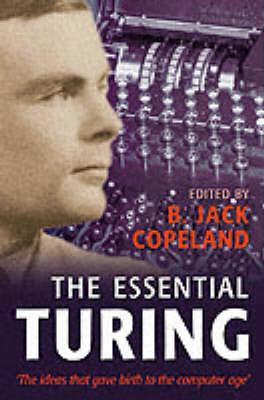
Alan Turing, pioneer of computing and WWII codebreaker, is one of the most important and influential thinkers of the twentieth century. In this volume for the first time his key writings are made available to a broad, non-specialist readership. They make fascinating reading both in their own right and for their historic significance: contemporary computational theory, cognitive science, artificial intelligence, and artificial life all spring from this ground-breaking
work, which is also rich in philosophical and logical insight. An introduction by leading Turing expert Jack Copeland provides the background and guides the reader through the selection.
About Alan Turing
Alan Turing FRS OBE, (1912-1954) studied mathematics at King's College, Cambridge. He was elected a Fellow of King's in March 1935, at the age of only 22. In the same year he invented the abstract computing machines - now known simply as Turing machines - on which all subsequent stored-program digital computers are modelled.
During 1936-1938 Turing continued his studies, now at Princeton University. He completed a PhD in mathematical logic, analysing the notion of 'intuition' in mathematics and introducing the idea of oracular computation, now fundamental in mathematical recursion theory. An 'oracle' is an abstract device able to solve mathematical problems too difficult for the universal Turing machine.
In the summer of 1938 Turing returned to his Fellowship at King's. When WWII started in 1939 he joined the wartime headquarters of the Government Code and Cypher School (GC&CS) at Bletchley Park, Buckinghamshire. Building on earlier work by Polish cryptanalysts, Turing contributed crucially to the design of electro-mechanical machines ('bombes') used to decipher Enigma, the code by means of which the German armed forces sought to protect their radio communications. Turing's work on the
version of Enigma used by the German navy was vital to the battle for supremacy in the North Atlantic. He also contributed to the attack on the cyphers known as 'Fish'. Based on binary teleprinter code, Fish was used during the latter part of the war in preference to morse-based Enigma for the encryption of
high-level signals, for e
work, which is also rich in philosophical and logical insight. An introduction by leading Turing expert Jack Copeland provides the background and guides the reader through the selection.
About Alan Turing
Alan Turing FRS OBE, (1912-1954) studied mathematics at King's College, Cambridge. He was elected a Fellow of King's in March 1935, at the age of only 22. In the same year he invented the abstract computing machines - now known simply as Turing machines - on which all subsequent stored-program digital computers are modelled.
During 1936-1938 Turing continued his studies, now at Princeton University. He completed a PhD in mathematical logic, analysing the notion of 'intuition' in mathematics and introducing the idea of oracular computation, now fundamental in mathematical recursion theory. An 'oracle' is an abstract device able to solve mathematical problems too difficult for the universal Turing machine.
In the summer of 1938 Turing returned to his Fellowship at King's. When WWII started in 1939 he joined the wartime headquarters of the Government Code and Cypher School (GC&CS) at Bletchley Park, Buckinghamshire. Building on earlier work by Polish cryptanalysts, Turing contributed crucially to the design of electro-mechanical machines ('bombes') used to decipher Enigma, the code by means of which the German armed forces sought to protect their radio communications. Turing's work on the
version of Enigma used by the German navy was vital to the battle for supremacy in the North Atlantic. He also contributed to the attack on the cyphers known as 'Fish'. Based on binary teleprinter code, Fish was used during the latter part of the war in preference to morse-based Enigma for the encryption of
high-level signals, for e
PRP: 392.67 Lei

Acesta este Prețul Recomandat de Producător. Prețul de vânzare al produsului este afișat mai jos.
314.14Lei
314.14Lei
392.67 LeiPrimești 314 puncte
Livrare in 2-4 saptamani
Descrierea produsului
Alan Turing, pioneer of computing and WWII codebreaker, is one of the most important and influential thinkers of the twentieth century. In this volume for the first time his key writings are made available to a broad, non-specialist readership. They make fascinating reading both in their own right and for their historic significance: contemporary computational theory, cognitive science, artificial intelligence, and artificial life all spring from this ground-breaking
work, which is also rich in philosophical and logical insight. An introduction by leading Turing expert Jack Copeland provides the background and guides the reader through the selection.
About Alan Turing
Alan Turing FRS OBE, (1912-1954) studied mathematics at King's College, Cambridge. He was elected a Fellow of King's in March 1935, at the age of only 22. In the same year he invented the abstract computing machines - now known simply as Turing machines - on which all subsequent stored-program digital computers are modelled.
During 1936-1938 Turing continued his studies, now at Princeton University. He completed a PhD in mathematical logic, analysing the notion of 'intuition' in mathematics and introducing the idea of oracular computation, now fundamental in mathematical recursion theory. An 'oracle' is an abstract device able to solve mathematical problems too difficult for the universal Turing machine.
In the summer of 1938 Turing returned to his Fellowship at King's. When WWII started in 1939 he joined the wartime headquarters of the Government Code and Cypher School (GC&CS) at Bletchley Park, Buckinghamshire. Building on earlier work by Polish cryptanalysts, Turing contributed crucially to the design of electro-mechanical machines ('bombes') used to decipher Enigma, the code by means of which the German armed forces sought to protect their radio communications. Turing's work on the
version of Enigma used by the German navy was vital to the battle for supremacy in the North Atlantic. He also contributed to the attack on the cyphers known as 'Fish'. Based on binary teleprinter code, Fish was used during the latter part of the war in preference to morse-based Enigma for the encryption of
high-level signals, for e
work, which is also rich in philosophical and logical insight. An introduction by leading Turing expert Jack Copeland provides the background and guides the reader through the selection.
About Alan Turing
Alan Turing FRS OBE, (1912-1954) studied mathematics at King's College, Cambridge. He was elected a Fellow of King's in March 1935, at the age of only 22. In the same year he invented the abstract computing machines - now known simply as Turing machines - on which all subsequent stored-program digital computers are modelled.
During 1936-1938 Turing continued his studies, now at Princeton University. He completed a PhD in mathematical logic, analysing the notion of 'intuition' in mathematics and introducing the idea of oracular computation, now fundamental in mathematical recursion theory. An 'oracle' is an abstract device able to solve mathematical problems too difficult for the universal Turing machine.
In the summer of 1938 Turing returned to his Fellowship at King's. When WWII started in 1939 he joined the wartime headquarters of the Government Code and Cypher School (GC&CS) at Bletchley Park, Buckinghamshire. Building on earlier work by Polish cryptanalysts, Turing contributed crucially to the design of electro-mechanical machines ('bombes') used to decipher Enigma, the code by means of which the German armed forces sought to protect their radio communications. Turing's work on the
version of Enigma used by the German navy was vital to the battle for supremacy in the North Atlantic. He also contributed to the attack on the cyphers known as 'Fish'. Based on binary teleprinter code, Fish was used during the latter part of the war in preference to morse-based Enigma for the encryption of
high-level signals, for e
Detaliile produsului



