







Eureka: A Prose Poem
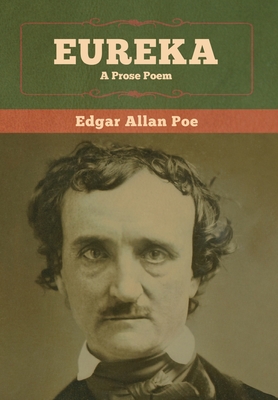
Eureka: A Prose Poem
Eureka (1848) is a lengthy non-fiction work by American author Edgar Allan Poe (1809-1849) which he subtitled "A Prose Poem", though it has also been subtitled as "An Essay on the Material and Spiritual Universe". Adapted from a lecture he had presented, Eureka describes Poe's intuitive conception of the nature of the universe with no antecedent scientific work done to reach his conclusions. He also discusses man's relationship with God, whom he compares to an author. It is dedicated to the German naturalist and explorer Alexander von Humboldt (1769-1859).
Though it is generally considered a literary work, some of Poe's ideas anticipate 20th-century scientific discoveries and theories. Indeed, a critical analysis of the scientific content of Eureka reveals a non-causal correspondence with modern cosmology due to the assumption of an evolving Universe, but excludes the anachronistic anticipation of relativistic concepts such as black holes.
Eureka was received poorly in Poe's day and generally described as absurd, even by friends. Modern critics continue to debate the significance of Eureka and some doubt its seriousness, in part because of Poe's many incorrect assumptions and his comedic descriptions of well-known historical minds. It is presented as a poem, and many compare it with his fiction work, especially science fiction stories such as "The Facts in the Case of M. Valdemar". His attempts at discovering the truth also follow his own tradition of "ratiocination", a term used in his detective fiction tales. Poe's suggestion that the soul continues to thrive even after death also parallels with works in which characters reappear from beyond the grave such as "Ligeia". The essay is oddly transcendental, considering Poe's disdain for that movement. He considered it his greatest work and claimed it was more important than the discovery of gravity. (wikipedia.org)
PRP: 235.11 Lei

Acesta este Prețul Recomandat de Producător. Prețul de vânzare al produsului este afișat mai jos.
211.60Lei
211.60Lei
235.11 LeiPrimești 211 puncte
Indisponibil
Descrierea produsului
Eureka (1848) is a lengthy non-fiction work by American author Edgar Allan Poe (1809-1849) which he subtitled "A Prose Poem", though it has also been subtitled as "An Essay on the Material and Spiritual Universe". Adapted from a lecture he had presented, Eureka describes Poe's intuitive conception of the nature of the universe with no antecedent scientific work done to reach his conclusions. He also discusses man's relationship with God, whom he compares to an author. It is dedicated to the German naturalist and explorer Alexander von Humboldt (1769-1859).
Though it is generally considered a literary work, some of Poe's ideas anticipate 20th-century scientific discoveries and theories. Indeed, a critical analysis of the scientific content of Eureka reveals a non-causal correspondence with modern cosmology due to the assumption of an evolving Universe, but excludes the anachronistic anticipation of relativistic concepts such as black holes.
Eureka was received poorly in Poe's day and generally described as absurd, even by friends. Modern critics continue to debate the significance of Eureka and some doubt its seriousness, in part because of Poe's many incorrect assumptions and his comedic descriptions of well-known historical minds. It is presented as a poem, and many compare it with his fiction work, especially science fiction stories such as "The Facts in the Case of M. Valdemar". His attempts at discovering the truth also follow his own tradition of "ratiocination", a term used in his detective fiction tales. Poe's suggestion that the soul continues to thrive even after death also parallels with works in which characters reappear from beyond the grave such as "Ligeia". The essay is oddly transcendental, considering Poe's disdain for that movement. He considered it his greatest work and claimed it was more important than the discovery of gravity. (wikipedia.org)
Detaliile produsului



