








Genealogies of Art, or the History of Art as Visual Art
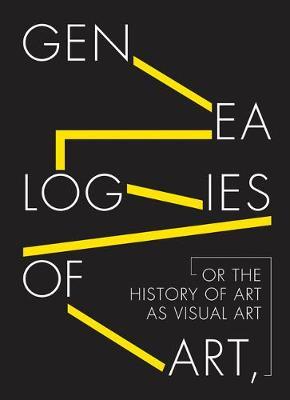
Genealogies of Art, or the History of Art as Visual Art
How artists, historians and theorists have diagrammed art's lineages, from the Middle Ages to Fluxus
Genealogies of Art analyzes the visual representations of art history made by artists, critics, designers, theorists and poets alike, from the genealogical trees of the 12th through the 15th centuries and the Renaissance to more recent information graphics, including paintings, sketches, maps, plans, prints, drawings and diagrams. The conceptual core of the book is the famed chart that Alfred H. Barr, first director of the Museum of Modern Art, composed for the cover of his landmark exhibition Cubism and Abstract Art in 1936, which sought to trace the origins of abstract art from 1890 to 1936. Around this paradigmatic chart is gathered a tremendous pageant of works by great polymaths and thinkers, including Guy Debord's situationist maps; the Guerrilla Girls' "Guerrillas in the Midst of History"; Athanasius Kircher's baroque-era trees of knowledge; George Maciunas' Fluxus diagrams; André Malraux's Museum without Walls; Otto Neurath's charts and isotypes; Ad Reinhardt's collaged histories of art; Ward Shelley's Who Invented the Avant-Garde?; Maurice Stein, Larry Miller and Marshall Henrichs' Blueprint for Counter Education; Aby Warburg's legendary Mnemosyne Atlas; and many others. Across 450 pages, Genealogies of Art reproduces more than 500 images. In addition to these, Astrit Schmidt-Burkhardt contributes an essay titled "The Diagrammatic Shift," following by Manuel Lima's "Trees of Knowledge: The Diagrammatic Traditions of the Middle Ages and the Renaissance," both of which contextualize the relevance of this form throughout history. Uwe Fleckner explores the use of diagrammatic visualization in curatorial and collecting activities, as in the cases of Carl Einstein or Aby Warburg; and the Picasso specialist Eugenio Carmona looks at Alfred H. Barr's conception of Picasso's work, in his text "Barr, Cubism and Picasso: Paradigm and 'Anti-paradigm.'"
Genealogies of Art analyzes the visual representations of art history made by artists, critics, designers, theorists and poets alike, from the genealogical trees of the 12th through the 15th centuries and the Renaissance to more recent information graphics, including paintings, sketches, maps, plans, prints, drawings and diagrams. The conceptual core of the book is the famed chart that Alfred H. Barr, first director of the Museum of Modern Art, composed for the cover of his landmark exhibition Cubism and Abstract Art in 1936, which sought to trace the origins of abstract art from 1890 to 1936. Around this paradigmatic chart is gathered a tremendous pageant of works by great polymaths and thinkers, including Guy Debord's situationist maps; the Guerrilla Girls' "Guerrillas in the Midst of History"; Athanasius Kircher's baroque-era trees of knowledge; George Maciunas' Fluxus diagrams; André Malraux's Museum without Walls; Otto Neurath's charts and isotypes; Ad Reinhardt's collaged histories of art; Ward Shelley's Who Invented the Avant-Garde?; Maurice Stein, Larry Miller and Marshall Henrichs' Blueprint for Counter Education; Aby Warburg's legendary Mnemosyne Atlas; and many others. Across 450 pages, Genealogies of Art reproduces more than 500 images. In addition to these, Astrit Schmidt-Burkhardt contributes an essay titled "The Diagrammatic Shift," following by Manuel Lima's "Trees of Knowledge: The Diagrammatic Traditions of the Middle Ages and the Renaissance," both of which contextualize the relevance of this form throughout history. Uwe Fleckner explores the use of diagrammatic visualization in curatorial and collecting activities, as in the cases of Carl Einstein or Aby Warburg; and the Picasso specialist Eugenio Carmona looks at Alfred H. Barr's conception of Picasso's work, in his text "Barr, Cubism and Picasso: Paradigm and 'Anti-paradigm.'"
PRP: 478.83 Lei

Acesta este Prețul Recomandat de Producător. Prețul de vânzare al produsului este afișat mai jos.
430.95Lei
430.95Lei
478.83 LeiPrimești 430 puncte

Indisponibil
Descrierea produsului
How artists, historians and theorists have diagrammed art's lineages, from the Middle Ages to Fluxus
Genealogies of Art analyzes the visual representations of art history made by artists, critics, designers, theorists and poets alike, from the genealogical trees of the 12th through the 15th centuries and the Renaissance to more recent information graphics, including paintings, sketches, maps, plans, prints, drawings and diagrams. The conceptual core of the book is the famed chart that Alfred H. Barr, first director of the Museum of Modern Art, composed for the cover of his landmark exhibition Cubism and Abstract Art in 1936, which sought to trace the origins of abstract art from 1890 to 1936. Around this paradigmatic chart is gathered a tremendous pageant of works by great polymaths and thinkers, including Guy Debord's situationist maps; the Guerrilla Girls' "Guerrillas in the Midst of History"; Athanasius Kircher's baroque-era trees of knowledge; George Maciunas' Fluxus diagrams; André Malraux's Museum without Walls; Otto Neurath's charts and isotypes; Ad Reinhardt's collaged histories of art; Ward Shelley's Who Invented the Avant-Garde?; Maurice Stein, Larry Miller and Marshall Henrichs' Blueprint for Counter Education; Aby Warburg's legendary Mnemosyne Atlas; and many others. Across 450 pages, Genealogies of Art reproduces more than 500 images. In addition to these, Astrit Schmidt-Burkhardt contributes an essay titled "The Diagrammatic Shift," following by Manuel Lima's "Trees of Knowledge: The Diagrammatic Traditions of the Middle Ages and the Renaissance," both of which contextualize the relevance of this form throughout history. Uwe Fleckner explores the use of diagrammatic visualization in curatorial and collecting activities, as in the cases of Carl Einstein or Aby Warburg; and the Picasso specialist Eugenio Carmona looks at Alfred H. Barr's conception of Picasso's work, in his text "Barr, Cubism and Picasso: Paradigm and 'Anti-paradigm.'"
Genealogies of Art analyzes the visual representations of art history made by artists, critics, designers, theorists and poets alike, from the genealogical trees of the 12th through the 15th centuries and the Renaissance to more recent information graphics, including paintings, sketches, maps, plans, prints, drawings and diagrams. The conceptual core of the book is the famed chart that Alfred H. Barr, first director of the Museum of Modern Art, composed for the cover of his landmark exhibition Cubism and Abstract Art in 1936, which sought to trace the origins of abstract art from 1890 to 1936. Around this paradigmatic chart is gathered a tremendous pageant of works by great polymaths and thinkers, including Guy Debord's situationist maps; the Guerrilla Girls' "Guerrillas in the Midst of History"; Athanasius Kircher's baroque-era trees of knowledge; George Maciunas' Fluxus diagrams; André Malraux's Museum without Walls; Otto Neurath's charts and isotypes; Ad Reinhardt's collaged histories of art; Ward Shelley's Who Invented the Avant-Garde?; Maurice Stein, Larry Miller and Marshall Henrichs' Blueprint for Counter Education; Aby Warburg's legendary Mnemosyne Atlas; and many others. Across 450 pages, Genealogies of Art reproduces more than 500 images. In addition to these, Astrit Schmidt-Burkhardt contributes an essay titled "The Diagrammatic Shift," following by Manuel Lima's "Trees of Knowledge: The Diagrammatic Traditions of the Middle Ages and the Renaissance," both of which contextualize the relevance of this form throughout history. Uwe Fleckner explores the use of diagrammatic visualization in curatorial and collecting activities, as in the cases of Carl Einstein or Aby Warburg; and the Picasso specialist Eugenio Carmona looks at Alfred H. Barr's conception of Picasso's work, in his text "Barr, Cubism and Picasso: Paradigm and 'Anti-paradigm.'"
Detaliile produsului




