





Honoring the Circle: Ongoing Learning from American Indians on Politics and Society, Volume II: The Continuing Impact of American Indian Wa
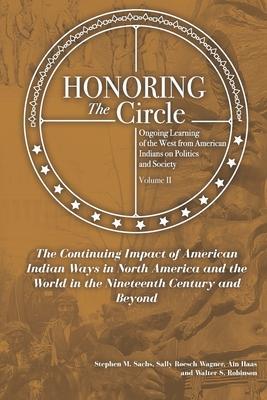
Honoring the Circle: Ongoing Learning from American Indians on Politics and Society, Volume II: The Continuing Impact of American Indian Wa
Honoring the Circle: Ongoing Learning from American Indians on Politics and Society, Volume II: The Continuing Impact of American Indian Ways in North America and the World in the Nineteenth Century and Beyond shows the continuing dynamics of the strands of American Indian influenced thought, begun among colonists and founding Americans, shaping the U.S. with new Native influences. This was well recognized among Americans in 1800, who considered themselves a fusion of the European and the Indian. Andrew Jackson's forced removal of Indians to the west began to hide that reality. This can be seen with European image of the Indian Goddess, first envisioned as dressed in buckskins and feathers; by the time her statue was placed atop the U.S. capitol in 1863 as the Goddess of Liberty, the outer clothing had become that of a Roman Goddess, but the Indian Woman remained beneath.Early in the nineteenth century Indian influences were plainly visible in the writings of John C. Calhoun and in the many Tammany Societies, including New York's Tammany Hall, founded to promote discussion of issues of the day and named in honor of a Delaware chief. Building on the influence of Franklin, Jefferson and others, an American Philosophy of Pragmatism developed, with strong Native roots among its interacting strands. Important contributors were Emerson and Thoreau, who had considerable contact with Indians, and later Jane Addams, James, Peirce and Dewey. Indian voices that shaped U.S. affairs included those of William Apess, Black Hawk, Elias Boudinot and George Copway. Indian influences have continued in Pragmatism's off-shoots and interactions, blossoming in the twenty-first century with President Obama and the current progressive movement.The Women's liberation movement began at contact, as Europeans saw the balanced reciprocity of women and men in Native communities. Among its early advocates who had close relations with Indians were Lydia Maria Child and Catharine Maria Sedgwick. Later, Matilda Joslyn Gage and others were inspired by Haudenosaunee women, as the women's movement became a major force. From the start, the women's movement was involved with civil rights broadly, including Indian rights, with women forming much of the core of anti-slavery movement. The movement for African-American rights has long had Native and Pragmatic roots in the valuing of diversity, as seen in the work of W. E. B. Du Bois, Martin Luther King Jr., Richard Wright and Cornell West. The
PRP: 146.86 Lei

Acesta este Prețul Recomandat de Producător. Prețul de vânzare al produsului este afișat mai jos.
132.17Lei
132.17Lei
146.86 LeiPrimești 132 puncte
Livrare in 2-4 saptamani
Descrierea produsului
Honoring the Circle: Ongoing Learning from American Indians on Politics and Society, Volume II: The Continuing Impact of American Indian Ways in North America and the World in the Nineteenth Century and Beyond shows the continuing dynamics of the strands of American Indian influenced thought, begun among colonists and founding Americans, shaping the U.S. with new Native influences. This was well recognized among Americans in 1800, who considered themselves a fusion of the European and the Indian. Andrew Jackson's forced removal of Indians to the west began to hide that reality. This can be seen with European image of the Indian Goddess, first envisioned as dressed in buckskins and feathers; by the time her statue was placed atop the U.S. capitol in 1863 as the Goddess of Liberty, the outer clothing had become that of a Roman Goddess, but the Indian Woman remained beneath.Early in the nineteenth century Indian influences were plainly visible in the writings of John C. Calhoun and in the many Tammany Societies, including New York's Tammany Hall, founded to promote discussion of issues of the day and named in honor of a Delaware chief. Building on the influence of Franklin, Jefferson and others, an American Philosophy of Pragmatism developed, with strong Native roots among its interacting strands. Important contributors were Emerson and Thoreau, who had considerable contact with Indians, and later Jane Addams, James, Peirce and Dewey. Indian voices that shaped U.S. affairs included those of William Apess, Black Hawk, Elias Boudinot and George Copway. Indian influences have continued in Pragmatism's off-shoots and interactions, blossoming in the twenty-first century with President Obama and the current progressive movement.The Women's liberation movement began at contact, as Europeans saw the balanced reciprocity of women and men in Native communities. Among its early advocates who had close relations with Indians were Lydia Maria Child and Catharine Maria Sedgwick. Later, Matilda Joslyn Gage and others were inspired by Haudenosaunee women, as the women's movement became a major force. From the start, the women's movement was involved with civil rights broadly, including Indian rights, with women forming much of the core of anti-slavery movement. The movement for African-American rights has long had Native and Pragmatic roots in the valuing of diversity, as seen in the work of W. E. B. Du Bois, Martin Luther King Jr., Richard Wright and Cornell West. The
Detaliile produsului



