





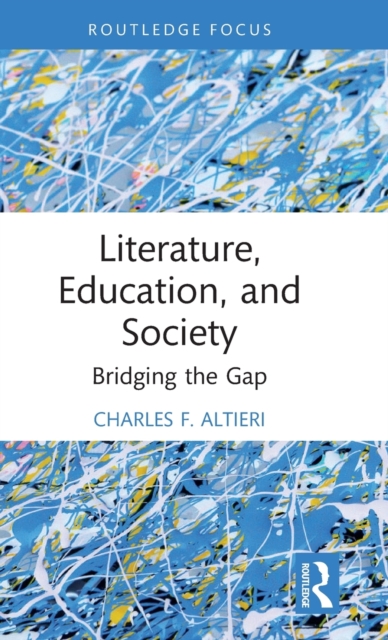
Literature, Education, and Society: Bridging the Gap
In today's classrooms, educators specializing in literature and the arts have found themselves facing an escalating crisis. Most obviously, they encounter serious budget cuts, largely because students tend in increasing numbers to prefer majoring in disciplines that provide clear, practical knowledge and the promise of relatively lucrative careers. These educators have addressed the crisis by stressing how the arts can also provide valuable forms of knowledge by testing moral values and by developing the skills of critical thinking required to understand the cost of apparently perennial social problems. Literature, Education, and Society offers a fresh strategy by focusing not on knowledge but on how literature and the arts provide distinctive domains of experience that stress significant values not typically provided by other disciplines. Practical disciplines tend to treat experiences as instances for which we learn to provide interpretive generalizations, making knowledge possible and helping us establish concrete programs for acting in accord with what we come to know. But the arts do not encourage generalizing from particulars. Instead they emphasize how to appreciate the particulars for qualities like sensitivity, intensity, and the capacity to solicit empathy. In order to dramatize this crucial difference, this book distinguishes sharply between a focus on "experience of" what solicits knowledge and a focus on "experience as" which encourages careful attention to what can be embedded in particular experiences. Then the book characterizes the making of art as an act of doubling. where the making fashions some aspect of experience and invites self-conscious participation in the intensity provided by the particular work. After exploring several aspects of doubling, the book turns to the vexed question of ethics, arguing that while this theory cannot persuade us that the arts improve behavior, its stress on art's purposive structuring of experience can affect how people construct values, something essential to education itself.
PRP: 435.11 Lei

Acesta este Prețul Recomandat de Producător. Prețul de vânzare al produsului este afișat mai jos.
391.60Lei
391.60Lei
435.11 LeiPrimești 391 puncte

Indisponibil
Descrierea produsului
In today's classrooms, educators specializing in literature and the arts have found themselves facing an escalating crisis. Most obviously, they encounter serious budget cuts, largely because students tend in increasing numbers to prefer majoring in disciplines that provide clear, practical knowledge and the promise of relatively lucrative careers. These educators have addressed the crisis by stressing how the arts can also provide valuable forms of knowledge by testing moral values and by developing the skills of critical thinking required to understand the cost of apparently perennial social problems. Literature, Education, and Society offers a fresh strategy by focusing not on knowledge but on how literature and the arts provide distinctive domains of experience that stress significant values not typically provided by other disciplines. Practical disciplines tend to treat experiences as instances for which we learn to provide interpretive generalizations, making knowledge possible and helping us establish concrete programs for acting in accord with what we come to know. But the arts do not encourage generalizing from particulars. Instead they emphasize how to appreciate the particulars for qualities like sensitivity, intensity, and the capacity to solicit empathy. In order to dramatize this crucial difference, this book distinguishes sharply between a focus on "experience of" what solicits knowledge and a focus on "experience as" which encourages careful attention to what can be embedded in particular experiences. Then the book characterizes the making of art as an act of doubling. where the making fashions some aspect of experience and invites self-conscious participation in the intensity provided by the particular work. After exploring several aspects of doubling, the book turns to the vexed question of ethics, arguing that while this theory cannot persuade us that the arts improve behavior, its stress on art's purposive structuring of experience can affect how people construct values, something essential to education itself.
Detaliile produsului