





Making Machines of Animals: The International Livestock Exposition
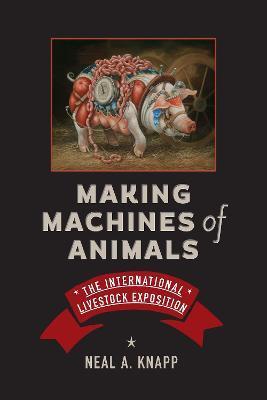
Making Machines of Animals: The International Livestock Exposition
How the Chicago International Livestock Exposition leveraged the eugenics movement to transform animals into machines and industrialize American agriculture.
In 1900, the Chicago International Livestock Exposition became the epicenter of agricultural reform that focused on reinventing animals' bodies to fit a modern, industrial design. Chicago meatpackers partnered with land-grant university professors to create the International--a spectacle on the scale of a world's fair--with the intention of setting the standard for animal quality and, in doing so, transformed American agriculture.
In Making Machines of Animals, Neal A. Knapp explains the motivations of both the meatpackers and the professors, describing how they deployed the International to redefine animality itself. Both professors and packers hoped to replace so-called scrub livestock with "improved" animals and created a new taxonomy of animal quality based on the burgeoning eugenics movement. The International created novel definitions of animal superiority and codified new norms, resulting in a dramatic shift in animal weight, body size, and market age. These changes transformed the animals from multipurpose to single-purpose products. These standardized animals and their dependence on off-the-farm inputs and exchanges limited farmers' choices regarding husbandry and marketing, ultimately undermining any goals for balanced farming or the maintenance and regeneration of soil fertility.
Drawing on land-grant university research and publications, meatpacker records and propaganda, and newspaper and agricultural journal articles, Knapp critiques the supposed market-oriented, efficiency-driven industrial reforms proffered by the International, which were underpinned by irrational, racist ideologies. The livestock reform movement not only resulted in cruel and violent outcomes for animals but also led to twentieth-century crops and animal husbandry that were rife with inefficiencies and agricultural vulnerabilities.
PRP: 598.33 Lei

Acesta este Prețul Recomandat de Producător. Prețul de vânzare al produsului este afișat mai jos.
538.50Lei
538.50Lei
598.33 LeiPrimești 538 puncte
Livrare in 2-4 saptamani
Descrierea produsului
How the Chicago International Livestock Exposition leveraged the eugenics movement to transform animals into machines and industrialize American agriculture.
In 1900, the Chicago International Livestock Exposition became the epicenter of agricultural reform that focused on reinventing animals' bodies to fit a modern, industrial design. Chicago meatpackers partnered with land-grant university professors to create the International--a spectacle on the scale of a world's fair--with the intention of setting the standard for animal quality and, in doing so, transformed American agriculture.
In Making Machines of Animals, Neal A. Knapp explains the motivations of both the meatpackers and the professors, describing how they deployed the International to redefine animality itself. Both professors and packers hoped to replace so-called scrub livestock with "improved" animals and created a new taxonomy of animal quality based on the burgeoning eugenics movement. The International created novel definitions of animal superiority and codified new norms, resulting in a dramatic shift in animal weight, body size, and market age. These changes transformed the animals from multipurpose to single-purpose products. These standardized animals and their dependence on off-the-farm inputs and exchanges limited farmers' choices regarding husbandry and marketing, ultimately undermining any goals for balanced farming or the maintenance and regeneration of soil fertility.
Drawing on land-grant university research and publications, meatpacker records and propaganda, and newspaper and agricultural journal articles, Knapp critiques the supposed market-oriented, efficiency-driven industrial reforms proffered by the International, which were underpinned by irrational, racist ideologies. The livestock reform movement not only resulted in cruel and violent outcomes for animals but also led to twentieth-century crops and animal husbandry that were rife with inefficiencies and agricultural vulnerabilities.
Detaliile produsului



