




Countdown header img desk

MAI SUNT 00:00:00:00

MAI SUNT

X

Countdown header img  mob

MAI SUNT 00:00:00:00

MAI SUNT

X

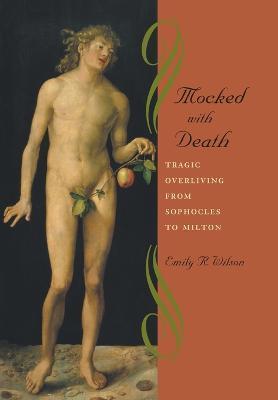
Mocked with Death: Tragic Overliving from Sophocles to Milton

De (autor): Emily R. Wilson

Mocked with Death: Tragic Overliving from Sophocles to Milton - Emily R. Wilson

Mocked with Death: Tragic Overliving from Sophocles to Milton

De (autor): Emily R. Wilson

In Paradise Lost, Adam asks, "Why do I overlive?" Adam's anguished question is the basis for a critical analysis of living too long as a neglected but central theme in Western tragic literature. Emily Wilson examines this experience in works by Milton and by four of his literary predecessors: Sophocles, Euripides, Seneca, and Shakespeare. Each of these writers composed works in which the central character undergoes unbearable suffering or loss, hopes for death, but goes on living.

Mocked with Death makes clear that tragic works need not find their moral and aesthetic conclusion in death and that, in some instances, tragedy consists of living on rather than dying. Oedipus's survival at the end of Oedipus Tyrannus and Oedipus Coloneus is clearly one such instance; another Euripides' Heracles. In Seneca's Hercules Furens, overliving becomes an expression of anxieties about both political and literary belatedness. In King Lear and Macbeth, the sense of overliving produces a divided sense of self. For Milton, in both Samson Agonistes and Paradise Lost, overliving is a theological problem arising from the tension between mortal conceptions of time and divine providence.

Each writer in this tradition, Wilson concludes, attempts to diminish the anxieties arising from living past one's time but cannot entirely minimize them. Tragedies of overliving remain disturbing because they remind us that life is rarely as neat as we expect and hope it be and that endings often come too late.

Citește mai mult

-10%

transport gratuit

PRP: 569.37 Lei

!

Acesta este Prețul Recomandat de Producător. Prețul de vânzare al produsului este afișat mai jos.

512.43Lei

512.43Lei

569.37 Lei

Primești 512 puncte

Important icon msg

Primești puncte de fidelitate după fiecare comandă! 100 puncte de fidelitate reprezintă 1 leu. Folosește-le la viitoarele achiziții!

Livrare in 2-4 saptamani

Plasează rapid comanda

Important icon msg

Poți comanda acest produs introducând numărul tău de telefon. În cel mai scurt timp vei fi apelat de un operator Libris pentru preluarea datelor necesare.

Completează mai jos numărul tău de telefon

Descrierea produsului

In Paradise Lost, Adam asks, "Why do I overlive?" Adam's anguished question is the basis for a critical analysis of living too long as a neglected but central theme in Western tragic literature. Emily Wilson examines this experience in works by Milton and by four of his literary predecessors: Sophocles, Euripides, Seneca, and Shakespeare. Each of these writers composed works in which the central character undergoes unbearable suffering or loss, hopes for death, but goes on living.

Mocked with Death makes clear that tragic works need not find their moral and aesthetic conclusion in death and that, in some instances, tragedy consists of living on rather than dying. Oedipus's survival at the end of Oedipus Tyrannus and Oedipus Coloneus is clearly one such instance; another Euripides' Heracles. In Seneca's Hercules Furens, overliving becomes an expression of anxieties about both political and literary belatedness. In King Lear and Macbeth, the sense of overliving produces a divided sense of self. For Milton, in both Samson Agonistes and Paradise Lost, overliving is a theological problem arising from the tension between mortal conceptions of time and divine providence.

Each writer in this tradition, Wilson concludes, attempts to diminish the anxieties arising from living past one's time but cannot entirely minimize them. Tragedies of overliving remain disturbing because they remind us that life is rarely as neat as we expect and hope it be and that endings often come too late.

Citește mai mult

S-ar putea să-ți placă și

De același autor

Părerea ta e inspirație pentru comunitatea Libris!

Istoricul tău de navigare

Acum se comandă

Noi suntem despre cărți, și la fel este și

Newsletter-ul nostru.

Abonează-te la veștile literare și primești un cupon de -10% pentru viitoarea ta comandă!

*Reducerea aplicată prin cupon nu se cumulează, ci se aplică reducerea cea mai mare.

Mă abonez image one
Mă abonez image one
Accessibility Logo

Salut! Te pot ajuta?

X



