





On Trial for Reason: Science, Religion, and Culture in the Galileo Affair
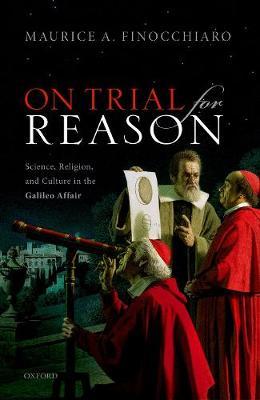
On Trial for Reason: Science, Religion, and Culture in the Galileo Affair
In 1633, the Roman Inquisition condemned Galileo as a suspected heretic for defending the astronomical theory that the earth moves, and implicitly assuming the theological principle that Scripture is not scientific authority. This controversial event has sent ripples down the centuries, embodying the struggle between a thinker who came to be regarded as the Father of Modern Science, and an institution that is both one of the world's greatest religions and most ancient organizations. The trial has been cited both as a clear demonstration of the incompatibility between science and religion, and also a stunning exemplar of rationality, scientific method, and critical thinking. Much has been written about Galileo's trial, but most works argue from a particular point of view - that of secular science against the Church, or justifying the religious position. Maurice Finocchiaro aims to provide a balanced historical account that draws out the cultural nuances. Unfolding the intriguing narrative of Galileo's trial, he sets it against its contemporary intellectual and philosophical background. In particular, Finocchiaro focuses on the contemporary arguments and evidence for and against the Earth's motion, which were based on astronomical observation, the physics of motion, philosophical principles about the nature of knowledge, and theological principles about the authority and the interpretation of Scripture. Following both sides of the controversy and its far-reaching philosophical impact, Finocchiaro unravels the complex relationship between science and religion, and demonstrates how Galileo came to be recognised as a model of logical reasoning.
PRP: 311.90 Lei

Acesta este Prețul Recomandat de Producător. Prețul de vânzare al produsului este afișat mai jos.
280.71Lei
280.71Lei
311.90 LeiPrimești 280 puncte
Livrare in 2-4 saptamani
Descrierea produsului
In 1633, the Roman Inquisition condemned Galileo as a suspected heretic for defending the astronomical theory that the earth moves, and implicitly assuming the theological principle that Scripture is not scientific authority. This controversial event has sent ripples down the centuries, embodying the struggle between a thinker who came to be regarded as the Father of Modern Science, and an institution that is both one of the world's greatest religions and most ancient organizations. The trial has been cited both as a clear demonstration of the incompatibility between science and religion, and also a stunning exemplar of rationality, scientific method, and critical thinking. Much has been written about Galileo's trial, but most works argue from a particular point of view - that of secular science against the Church, or justifying the religious position. Maurice Finocchiaro aims to provide a balanced historical account that draws out the cultural nuances. Unfolding the intriguing narrative of Galileo's trial, he sets it against its contemporary intellectual and philosophical background. In particular, Finocchiaro focuses on the contemporary arguments and evidence for and against the Earth's motion, which were based on astronomical observation, the physics of motion, philosophical principles about the nature of knowledge, and theological principles about the authority and the interpretation of Scripture. Following both sides of the controversy and its far-reaching philosophical impact, Finocchiaro unravels the complex relationship between science and religion, and demonstrates how Galileo came to be recognised as a model of logical reasoning.
Detaliile produsului



