







Piano Development L2
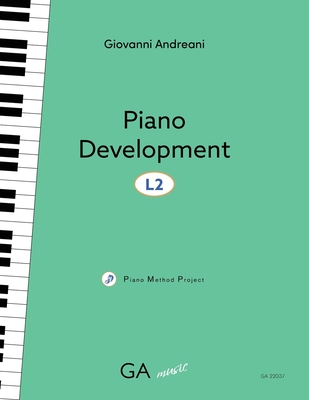
Piano Development L2
Piano Development (PD) is, throughout the PMP Development Areas, the main framework around which all other Development Areas orbit; it has been conceived to help piano teachers achieve a profound view of their student's improvements while guiding them throughout the higher levels of piano playing.
PD is divided into a first set of 20 levels and the student should be working on two different and consecutive levels at the same time.
The general complexity expressed at each level of PD does not have to be comparable to the difficulty of other areas simultaneously studied, especially if related to repertoire. Indeed, the student may find him/herself studying a repertoire piece that is much more difficult than is expressed by the level required in PD.
At this level all melodic lines are played by one hand at the time with no superimposition of a second melody or any other kind of melodic structure.
Some piecese will be played exclusevely with one hand while others will require the use of both hands: in this case the melody will pass from one hand to the other; a dotted line connecting the melody through the two staves will help visualizing the correct melodic outline. A melodic line passing from one hand to the other can be found in many cases in the keyboard literature; as an example, the inner voice (or voices) from a fugue, generally with more than two parts, may be performed alternately by the two hands.
When playing a melody without a contrapunctual line the student's inner hearing and sense of rhythm and control of durations4 will consistently develope; consequentely a sense of metre will strongly improve.
By following the PMP principles the student will be working on PD L1 or PD L3 together with this level; in the latter case, the student will be dealing with a mixed set of pieces composed for two hands playing simultaneously as well as pieces for two hands performing one only melody.
The introduction comprises directions for using this book, a description of all rhythmic patterns and time signatures found in the pieces and a description of the minimum prerequisites eventually needed for effectively starting this book. More specific direction for the teacher, related to a methodological approach to the pieces are also included; topics taken into consideration are:
AccidentalsHand positionsMetronomeFinding hand positions and improvising prior to practicing each pieceImprovising chamber musicKey
PRP: 130.14 Lei

Acesta este Prețul Recomandat de Producător. Prețul de vânzare al produsului este afișat mai jos.
117.13Lei
117.13Lei
130.14 LeiPrimești 117 puncte
Indisponibil
Descrierea produsului
Piano Development (PD) is, throughout the PMP Development Areas, the main framework around which all other Development Areas orbit; it has been conceived to help piano teachers achieve a profound view of their student's improvements while guiding them throughout the higher levels of piano playing.
PD is divided into a first set of 20 levels and the student should be working on two different and consecutive levels at the same time.
The general complexity expressed at each level of PD does not have to be comparable to the difficulty of other areas simultaneously studied, especially if related to repertoire. Indeed, the student may find him/herself studying a repertoire piece that is much more difficult than is expressed by the level required in PD.
At this level all melodic lines are played by one hand at the time with no superimposition of a second melody or any other kind of melodic structure.
Some piecese will be played exclusevely with one hand while others will require the use of both hands: in this case the melody will pass from one hand to the other; a dotted line connecting the melody through the two staves will help visualizing the correct melodic outline. A melodic line passing from one hand to the other can be found in many cases in the keyboard literature; as an example, the inner voice (or voices) from a fugue, generally with more than two parts, may be performed alternately by the two hands.
When playing a melody without a contrapunctual line the student's inner hearing and sense of rhythm and control of durations4 will consistently develope; consequentely a sense of metre will strongly improve.
By following the PMP principles the student will be working on PD L1 or PD L3 together with this level; in the latter case, the student will be dealing with a mixed set of pieces composed for two hands playing simultaneously as well as pieces for two hands performing one only melody.
The introduction comprises directions for using this book, a description of all rhythmic patterns and time signatures found in the pieces and a description of the minimum prerequisites eventually needed for effectively starting this book. More specific direction for the teacher, related to a methodological approach to the pieces are also included; topics taken into consideration are:
AccidentalsHand positionsMetronomeFinding hand positions and improvising prior to practicing each pieceImprovising chamber musicKey
Detaliile produsului



