







Protomusic: The role of Prosodic Modulation in the Emergence of Language
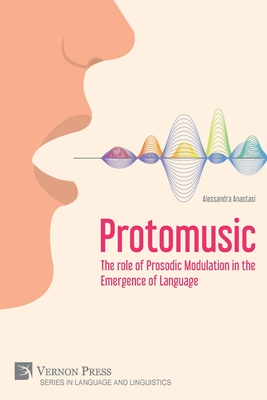
Protomusic: The role of Prosodic Modulation in the Emergence of Language
Anastasi introduces an alternative vision about language development and music involvement to the current scientific discourse. Her view is based on a rigorous evolutionary perspective, through which she not only demonstrates the hypothesis of vocal continuity with other species via morphological data but, more importantly, also demonstrates how music is first and foremost a biological and cognitive trait. The bond between animal and human communication is here interpreted as an interspecific universal with a clear evolutionary impact on the speech's natural history. Such continuity does not undermine the species-specificity of our linguistic system and, at the same time, supports the theory according to which music had a clear evolutionary role in the inception of the prosodic and musical components of speech. In leaning towards a bio-naturalistic approach, the most convincing view is that of a vocal and functional continuity of music. This appears to be demonstrable through the evolutionary past of vocality in other animal species, not constrained from having some form of cultural transmission.
The book evidences that the current research scenario on non-human animal communication benefits from the support of semiotics and, specifically, zoosemiotics. The latter approach enables us to interpret music and chant not only as a simple formal and meaningless exercise, but rather as a communicative element perceived and processed by organisms equipped with cognitive abilities. Anastasi argues that vocal continuity, made possible by biological constraints that mark its anatomical and physiological aspects, places human beings in a relationship of semiotic continuity with non-human communication forms. In turn, this enables us to better describe the phylogenetic processes which determined the development of musical behaviours in the Sapiens, as well as the way in which such behaviours interwove with the expressive vocality of the animal world.
PRP: 355.47 Lei

Acesta este Prețul Recomandat de Producător. Prețul de vânzare al produsului este afișat mai jos.
319.92Lei
319.92Lei
355.47 LeiPrimești 319 puncte
Livrare in 2-4 saptamani
Descrierea produsului
Anastasi introduces an alternative vision about language development and music involvement to the current scientific discourse. Her view is based on a rigorous evolutionary perspective, through which she not only demonstrates the hypothesis of vocal continuity with other species via morphological data but, more importantly, also demonstrates how music is first and foremost a biological and cognitive trait. The bond between animal and human communication is here interpreted as an interspecific universal with a clear evolutionary impact on the speech's natural history. Such continuity does not undermine the species-specificity of our linguistic system and, at the same time, supports the theory according to which music had a clear evolutionary role in the inception of the prosodic and musical components of speech. In leaning towards a bio-naturalistic approach, the most convincing view is that of a vocal and functional continuity of music. This appears to be demonstrable through the evolutionary past of vocality in other animal species, not constrained from having some form of cultural transmission.
The book evidences that the current research scenario on non-human animal communication benefits from the support of semiotics and, specifically, zoosemiotics. The latter approach enables us to interpret music and chant not only as a simple formal and meaningless exercise, but rather as a communicative element perceived and processed by organisms equipped with cognitive abilities. Anastasi argues that vocal continuity, made possible by biological constraints that mark its anatomical and physiological aspects, places human beings in a relationship of semiotic continuity with non-human communication forms. In turn, this enables us to better describe the phylogenetic processes which determined the development of musical behaviours in the Sapiens, as well as the way in which such behaviours interwove with the expressive vocality of the animal world.
Detaliile produsului



