








Reconstruction and Empire: The Legacies of Abolition and Union Victory for an Imperial Age
Reconstruction and Empire: The Legacies of Abolition and Union Victory for an Imperial Age
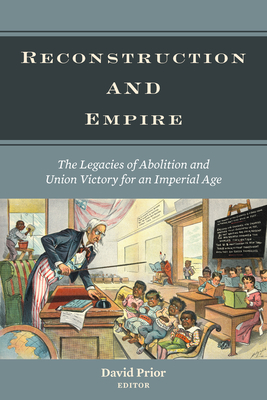
This volume examines the historical connections between the United States' Reconstruction and the country's emergence as a geopolitical power a few decades later. It shows how the processes at work during the postbellum decade variously foreshadowed, inhibited, and conditioned the development of the United States as an overseas empire and regional hegemon. In doing so, it links the diverse topics of abolition, diplomacy, Jim Crow, humanitarianism, and imperialism.
In 1935, the great African American intellectual W. E. B. Du Bois argued in his Black Reconstruction in America that these two historical moments were intimately related. In particular, Du Bois averred that the nation's betrayal of the South's fledgling interracial democracy in the 1870s put reactionaries in charge of a country on the verge of global power, with world-historical implications. Working with the same chronological and geographical parameters, the contributors here take up targeted case studies, tracing the biographical, ideological, and thematic linkages that stretch across the postbellum and imperial moments. With an Introduction, eleven chapters, and an Afterword, this volume offers multiple perspectives based on original primary source research. The resulting composite picture points to a host of countervailing continuities and changes. The contributors examine topics as diverse as diplomatic relations with Spain, the changing views of radical abolitionists, African American missionaries in the Caribbean, and the ambiguities of turn-of-the century political cartoons. Collectively, the volume unsettles familiar assumptions about how we should understand the late nineteenth-century United States, conventionally framed as the Gilded Age and Progressive Era. It also advances transnational approaches to understanding America's Reconstruction and the search for the ideological currents shaping American power abroad.PRP: 343.58 Lei

Acesta este Prețul Recomandat de Producător. Prețul de vânzare al produsului este afișat mai jos.
309.22Lei
309.22Lei
343.58 LeiPrimești 309 puncte

Indisponibil
Descrierea produsului
This volume examines the historical connections between the United States' Reconstruction and the country's emergence as a geopolitical power a few decades later. It shows how the processes at work during the postbellum decade variously foreshadowed, inhibited, and conditioned the development of the United States as an overseas empire and regional hegemon. In doing so, it links the diverse topics of abolition, diplomacy, Jim Crow, humanitarianism, and imperialism.
In 1935, the great African American intellectual W. E. B. Du Bois argued in his Black Reconstruction in America that these two historical moments were intimately related. In particular, Du Bois averred that the nation's betrayal of the South's fledgling interracial democracy in the 1870s put reactionaries in charge of a country on the verge of global power, with world-historical implications. Working with the same chronological and geographical parameters, the contributors here take up targeted case studies, tracing the biographical, ideological, and thematic linkages that stretch across the postbellum and imperial moments. With an Introduction, eleven chapters, and an Afterword, this volume offers multiple perspectives based on original primary source research. The resulting composite picture points to a host of countervailing continuities and changes. The contributors examine topics as diverse as diplomatic relations with Spain, the changing views of radical abolitionists, African American missionaries in the Caribbean, and the ambiguities of turn-of-the century political cartoons. Collectively, the volume unsettles familiar assumptions about how we should understand the late nineteenth-century United States, conventionally framed as the Gilded Age and Progressive Era. It also advances transnational approaches to understanding America's Reconstruction and the search for the ideological currents shaping American power abroad.Detaliile produsului