







Shakespearean Issues: Agency, Skepticism, and Other Puzzles
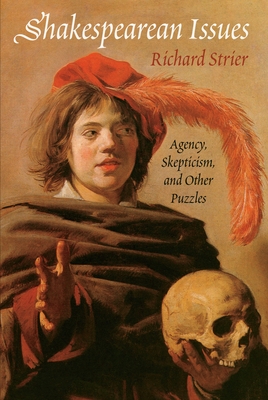
Shakespearean Issues: Agency, Skepticism, and Other Puzzles
In Shakespearean Issues, Richard Strier has written a set of linked essays bound by a learned view of how to think about Shakespeare's plays and also how to write literary criticism on them. The essays vary in their foci--from dealing with passages and key lines to dealing with whole plays, and to dealing with multiple plays in thematic conversation with each other. Strier treats the political, social, and philosophical themes of Shakespeare's plays through recursive and revisionary close reading, revisiting plays from different angles and often contravening prevailing views.
Part I focuses on characters. Moments of bad faith, of unconscious self-revelation, and of semi-conscious self-revelation are analyzed, along with the problem of describing characters psychologically and ethically. In an essay on "Happy Hamlet," the famous melancholy of the prince is questioned, as is the villainy of Rosencrantz and Guildenstern, while another essay asks the reader to reconsider moral judgments and negative assessments of characters who may be flawed but do not seem obviously wicked, such as Edgar and Gloucester in King Lear. Part II moves to systems, arguing that Henry IV, Measure for Measure, and The Merchant of Venice raise doubts about fundamental features of legal systems, such as impartiality, punishments, and respect for contracts. Strier reveals King Lear's radicalism, analyzing its concentration on poverty and its insistence on the existence and legitimacy of a material substratum to human life. Essays on The Tempest offer original takes on the play's presentation of coercive power, of civilization and its discontents, and of humanist ideals. Part III turns to religious and epistemological beliefs, with Strier challenging prevailing views of Shakespeare's relation to both. A culminating reading sees The Winter's Tale as ultimately affirming the mind's capacities, and as finding a place for something like religion within the world. Anyone interested in Shakespeare's plays will find Shakespearean Issues bracing and thought-provoking.PRP: 614.39 Lei

Acesta este Prețul Recomandat de Producător. Prețul de vânzare al produsului este afișat mai jos.
552.95Lei
552.95Lei
614.39 LeiPrimești 552 puncte
Indisponibil
Descrierea produsului
In Shakespearean Issues, Richard Strier has written a set of linked essays bound by a learned view of how to think about Shakespeare's plays and also how to write literary criticism on them. The essays vary in their foci--from dealing with passages and key lines to dealing with whole plays, and to dealing with multiple plays in thematic conversation with each other. Strier treats the political, social, and philosophical themes of Shakespeare's plays through recursive and revisionary close reading, revisiting plays from different angles and often contravening prevailing views.
Part I focuses on characters. Moments of bad faith, of unconscious self-revelation, and of semi-conscious self-revelation are analyzed, along with the problem of describing characters psychologically and ethically. In an essay on "Happy Hamlet," the famous melancholy of the prince is questioned, as is the villainy of Rosencrantz and Guildenstern, while another essay asks the reader to reconsider moral judgments and negative assessments of characters who may be flawed but do not seem obviously wicked, such as Edgar and Gloucester in King Lear. Part II moves to systems, arguing that Henry IV, Measure for Measure, and The Merchant of Venice raise doubts about fundamental features of legal systems, such as impartiality, punishments, and respect for contracts. Strier reveals King Lear's radicalism, analyzing its concentration on poverty and its insistence on the existence and legitimacy of a material substratum to human life. Essays on The Tempest offer original takes on the play's presentation of coercive power, of civilization and its discontents, and of humanist ideals. Part III turns to religious and epistemological beliefs, with Strier challenging prevailing views of Shakespeare's relation to both. A culminating reading sees The Winter's Tale as ultimately affirming the mind's capacities, and as finding a place for something like religion within the world. Anyone interested in Shakespeare's plays will find Shakespearean Issues bracing and thought-provoking.Detaliile produsului



