





Stark Tables: For Clearing the Lunar Distance and Finding Universal Time by Sextant Observation Including a Convenient Way to Sharpe
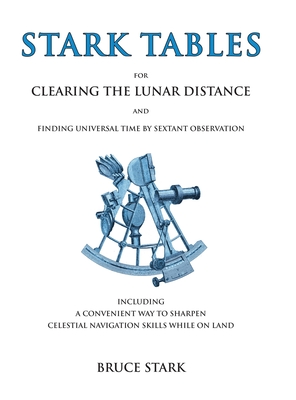
Stark Tables: For Clearing the Lunar Distance and Finding Universal Time by Sextant Observation Including a Convenient Way to Sharpe
Celestial navigation is a way to find your latitude and longitude on earth using a sextant to measure the angular heights of celestial bodies above the horizon. It has been used by mariners at sea and explorers on land for three hundred years, and it is still used today as a dependable backup to modern electronic navigation. Routine celestial navigation relies upon accurate time (Universal Time) to find the longitude of a position (latitude does not require time). Advanced celestial navigators can find longitude without knowing the time using a technique called Lunar Distance. In this technique, the sextant is used to measure the angular (diagonal) distance between the moon and another celestial body. Since this distance slowly changes as the moon moves eastward though the stars, it can be used to find the time of day that is needed to complete the longitude determination. The process of finding longitude from lunar distance, however, requires special tables that have not been published in the Nautical Almanac or other sources since the early 1900s. Although software solutions have been available, most advanced celestial navigators are very grateful to navigation historian Bruce Stark for creating these printed tables dedicated to this task. They have been used and tested by mariners for more than 15 years and are praised by experts for their ingenuity and ease of use in solving this complex navigation exercise-which all agree is the hallmark of an expert celestial navigator. With The Stark Tables in your nav station, you no longer have to fear losing power to your electronic navigation aids, nor are you dependent on accurate time from any official broadcast. Besides their practical use in back up navigation, historians have used these tables for years to interpret the logbooks of Lewis and Clark, David Thompson, James Cook, Matthew Flinders, George Vancouver, Nathaniel Bowditch, and other notable explorers and sea captains. "It is remarkable in this day when the very survival of celestial navigation seems in question, that an individual should suddenly appear on the scene and present to the world such a brilliant piece of work. Stark has rendered a great service to the celestial navigation community." - Robert Eno, The Navigator's Newsletter "Captain Cook would have relished using these tables, had they been available to him then." - George Huxtable, FRIN
PRP: 341.00 Lei

Acesta este Prețul Recomandat de Producător. Prețul de vânzare al produsului este afișat mai jos.
306.90Lei
306.90Lei
341.00 LeiPrimești 306 puncte
Livrare in 2-4 saptamani
Descrierea produsului
Celestial navigation is a way to find your latitude and longitude on earth using a sextant to measure the angular heights of celestial bodies above the horizon. It has been used by mariners at sea and explorers on land for three hundred years, and it is still used today as a dependable backup to modern electronic navigation. Routine celestial navigation relies upon accurate time (Universal Time) to find the longitude of a position (latitude does not require time). Advanced celestial navigators can find longitude without knowing the time using a technique called Lunar Distance. In this technique, the sextant is used to measure the angular (diagonal) distance between the moon and another celestial body. Since this distance slowly changes as the moon moves eastward though the stars, it can be used to find the time of day that is needed to complete the longitude determination. The process of finding longitude from lunar distance, however, requires special tables that have not been published in the Nautical Almanac or other sources since the early 1900s. Although software solutions have been available, most advanced celestial navigators are very grateful to navigation historian Bruce Stark for creating these printed tables dedicated to this task. They have been used and tested by mariners for more than 15 years and are praised by experts for their ingenuity and ease of use in solving this complex navigation exercise-which all agree is the hallmark of an expert celestial navigator. With The Stark Tables in your nav station, you no longer have to fear losing power to your electronic navigation aids, nor are you dependent on accurate time from any official broadcast. Besides their practical use in back up navigation, historians have used these tables for years to interpret the logbooks of Lewis and Clark, David Thompson, James Cook, Matthew Flinders, George Vancouver, Nathaniel Bowditch, and other notable explorers and sea captains. "It is remarkable in this day when the very survival of celestial navigation seems in question, that an individual should suddenly appear on the scene and present to the world such a brilliant piece of work. Stark has rendered a great service to the celestial navigation community." - Robert Eno, The Navigator's Newsletter "Captain Cook would have relished using these tables, had they been available to him then." - George Huxtable, FRIN
Detaliile produsului



