





The Devastation of the Indies: A Brief Account
The Devastation of the Indies: A Brief Account
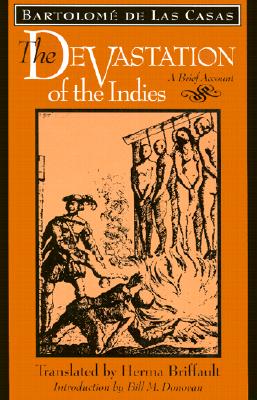
Five hundred years after Columbus's first voyage to the New World, the debate over the European impact on Native American civilization has grown more heated than ever. Among the first--and most insistent--voices raised in that debate was that of a Spanish priest, Bartolome de Las Casas, acquaintance of Cortes and Pizarro and shipmate of Velasquez on the voyage to conquer Cuba. In 1552, after forty years of witnessing--and opposing--countless acts of brutality in the new Spanish colonies, Las Casas returned to Seville, where he published a book that caused a storm of controversy that persists to the present day. The Devastation of the Indies is an eyewitness account of the first modern genocide, a story of greed, hypocrisy, and cruelties so grotesque as to rival the worst of our own century. Las Casas writes of men, women, and children burned alive "thirteen at a time in memory of Our Redeemer and his twelve apostles." He describes butcher shops that sold human flesh for dog food ("Give me a quarter of that rascal there, " one customer says, "until I can kill some more of my own"). Slave ship captains navigate "without need of compass or charts, " following instead the trail of floating corpses tossed overboard by the ship before them. Native kings are promised peace, then slaughtered. Whole families hang themselves in despair. Once-fertile islands are turned to desert, the wealth of nations plundered, millions killed outright, whole peoples annihilated. In an introduction, historian Bill M. Donovan provides a brief biography of Las Casas and reviews the controversy his work produced among Europeans, whose indignation--and denials--lasted centuries. But the book itself is short. "Were I t describe all this, " writes Las Casas of the four decades of suffering he witnessed, "no amount of time and paper could encompass this task."
PRP: 323.46 Lei

Acesta este Prețul Recomandat de Producător. Prețul de vânzare al produsului este afișat mai jos.
291.11Lei
291.11Lei
323.46 LeiPrimești 291 puncte
Livrare in 2-4 saptamani
Descrierea produsului
Five hundred years after Columbus's first voyage to the New World, the debate over the European impact on Native American civilization has grown more heated than ever. Among the first--and most insistent--voices raised in that debate was that of a Spanish priest, Bartolome de Las Casas, acquaintance of Cortes and Pizarro and shipmate of Velasquez on the voyage to conquer Cuba. In 1552, after forty years of witnessing--and opposing--countless acts of brutality in the new Spanish colonies, Las Casas returned to Seville, where he published a book that caused a storm of controversy that persists to the present day. The Devastation of the Indies is an eyewitness account of the first modern genocide, a story of greed, hypocrisy, and cruelties so grotesque as to rival the worst of our own century. Las Casas writes of men, women, and children burned alive "thirteen at a time in memory of Our Redeemer and his twelve apostles." He describes butcher shops that sold human flesh for dog food ("Give me a quarter of that rascal there, " one customer says, "until I can kill some more of my own"). Slave ship captains navigate "without need of compass or charts, " following instead the trail of floating corpses tossed overboard by the ship before them. Native kings are promised peace, then slaughtered. Whole families hang themselves in despair. Once-fertile islands are turned to desert, the wealth of nations plundered, millions killed outright, whole peoples annihilated. In an introduction, historian Bill M. Donovan provides a brief biography of Las Casas and reviews the controversy his work produced among Europeans, whose indignation--and denials--lasted centuries. But the book itself is short. "Were I t describe all this, " writes Las Casas of the four decades of suffering he witnessed, "no amount of time and paper could encompass this task."
Detaliile produsului



