








In the years between the American Revolution and the U.S. Civil War, as legal and cultural understandings of citizenship became more racially restrictive, black writers articulated an expansive, practice-based theory of citizenship. Grounded in political participation, mutual aid, critique and revolution, and the myriad daily interactions between people living in the same spaces, citizenship, they argued, is not defined by who one is but, rather, by what one does.
In The Practice of Citizenship, Derrick R. Spires examines the parallel development of early black print culture and legal and cultural understandings of U.S. citizenship, beginning in 1787, with the framing of the federal Constitution and the founding of the Free African Society by Absalom Jones and Richard Allen, and ending in 1861, with the onset of the Civil War. Between these two points he recovers understudied figures such as William J. Wilson, whose 1859 "Afric-American Picture Gallery" appeared in seven installments in The Anglo-African Magazine, and the physician, abolitionist, and essayist James McCune Smith. He places texts such as the proceedings of black state conventions alongside considerations of canonical figures such as Frances Ellen Watkins Harper and Frederick Douglass. Reading black print culture as a space where citizenship was both theorized and practiced, Spires reveals the degree to which concepts of black citizenship emerged through a highly creative and diverse community of letters, not easily reducible to representative figures or genres. From petitions to Congress to Frances Harper's parlor fiction, black writers framed citizenship both explicitly and implicitly, the book demonstrates, not simply as a response to white supremacy but as a matter of course in the shaping of their own communities and in meeting their own political, social, and cultural needs.The Practice of Citizenship: Black Politics and Print Culture in the Early United States
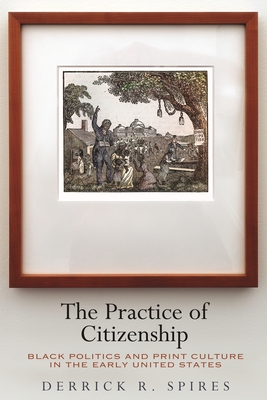
The Practice of Citizenship: Black Politics and Print Culture in the Early United States
PRP: 206.19 Lei

Acesta este Prețul Recomandat de Producător. Prețul de vânzare al produsului este afișat mai jos.
185.57Lei
185.57Lei
206.19 LeiPrimești 185 puncte

Indisponibil
Descrierea produsului
In the years between the American Revolution and the U.S. Civil War, as legal and cultural understandings of citizenship became more racially restrictive, black writers articulated an expansive, practice-based theory of citizenship. Grounded in political participation, mutual aid, critique and revolution, and the myriad daily interactions between people living in the same spaces, citizenship, they argued, is not defined by who one is but, rather, by what one does.
In The Practice of Citizenship, Derrick R. Spires examines the parallel development of early black print culture and legal and cultural understandings of U.S. citizenship, beginning in 1787, with the framing of the federal Constitution and the founding of the Free African Society by Absalom Jones and Richard Allen, and ending in 1861, with the onset of the Civil War. Between these two points he recovers understudied figures such as William J. Wilson, whose 1859 "Afric-American Picture Gallery" appeared in seven installments in The Anglo-African Magazine, and the physician, abolitionist, and essayist James McCune Smith. He places texts such as the proceedings of black state conventions alongside considerations of canonical figures such as Frances Ellen Watkins Harper and Frederick Douglass. Reading black print culture as a space where citizenship was both theorized and practiced, Spires reveals the degree to which concepts of black citizenship emerged through a highly creative and diverse community of letters, not easily reducible to representative figures or genres. From petitions to Congress to Frances Harper's parlor fiction, black writers framed citizenship both explicitly and implicitly, the book demonstrates, not simply as a response to white supremacy but as a matter of course in the shaping of their own communities and in meeting their own political, social, and cultural needs.Detaliile produsului




