








Thomas More on Statesmanship
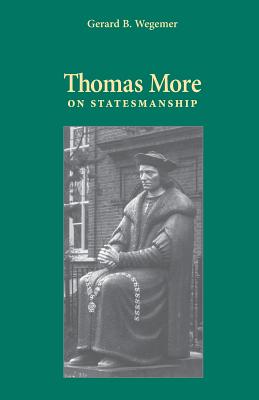
Thomas More on Statesmanship
The term "statesman" entered the English language during the Renaissance as a result of the widespread return to the Greek and Roman classics. Sir Thomas More, who brought his careful study of Plato and Aristotle, Cicero and Augustine to bear upon his political life, contributed most to the recovery of the ancient Greco-Roman concept of the statesman. Throughout More's writings and his actions one finds a consistent and principled approach to statesmanship that emphasizes the free character of the human person and integrates classical and Christian thought with the best of England's common law tradition of self-rule.
This study is the first to examine More's complete works in view of his concept of statesmanship, and, in the process, link More's humanism, his faith, and his legal and political vocations into a coherent narrative. In Part One Gerard B. Wegemer sets forth More's theory of statesmanship, drawing heavily from the entire corpus of his work. In the second part he presents More's understanding of literature and applies this understanding to his book Utopia. In Part Three he investigates the two most controversial events in More's life: his treatment of heretics and his refusal to obey his king. More presented a consistent defense of institutional arrangements now taken as basic to all democratic government: rule of law, division of power, separation of church and state, elected representation, and protected forms of free and public deliberation. He believed that the essential work of the statesman is to draw upon the nation's deepest and longest-standing consensus, as expressed in its literature and its laws, in order to govern with the people's consent. More was convinced that law, not individual persons, should rule.This book, which integrates the literature, philosophy, history, and politics of the Renaissance, will appeal across disciplines to scholars of early modern England and to anyone fascinated by the life and times of St. Thomas More. Gerard B. Wegemer is the author of Thomas More: A Portrait of Courage (1995) and has written about More and his times for such journals as Renascence, Philosophy and Rhetoric, Moreana, and The Review of Politics. He holds master's degrees in political philosophy and literature from Boston College and Georgetown respectively, and a doctorate in English literature from Notre Dame. He is associate professor of literature at the University of Dallas, and he teaches and lectures regularly on St. Thomas
PRP: 165.00 Lei

Acesta este Prețul Recomandat de Producător. Prețul de vânzare al produsului este afișat mai jos.
148.50Lei
148.50Lei
165.00 LeiPrimești 148 puncte

Livrare in 2-4 saptamani
Descrierea produsului
The term "statesman" entered the English language during the Renaissance as a result of the widespread return to the Greek and Roman classics. Sir Thomas More, who brought his careful study of Plato and Aristotle, Cicero and Augustine to bear upon his political life, contributed most to the recovery of the ancient Greco-Roman concept of the statesman. Throughout More's writings and his actions one finds a consistent and principled approach to statesmanship that emphasizes the free character of the human person and integrates classical and Christian thought with the best of England's common law tradition of self-rule.
This study is the first to examine More's complete works in view of his concept of statesmanship, and, in the process, link More's humanism, his faith, and his legal and political vocations into a coherent narrative. In Part One Gerard B. Wegemer sets forth More's theory of statesmanship, drawing heavily from the entire corpus of his work. In the second part he presents More's understanding of literature and applies this understanding to his book Utopia. In Part Three he investigates the two most controversial events in More's life: his treatment of heretics and his refusal to obey his king. More presented a consistent defense of institutional arrangements now taken as basic to all democratic government: rule of law, division of power, separation of church and state, elected representation, and protected forms of free and public deliberation. He believed that the essential work of the statesman is to draw upon the nation's deepest and longest-standing consensus, as expressed in its literature and its laws, in order to govern with the people's consent. More was convinced that law, not individual persons, should rule.This book, which integrates the literature, philosophy, history, and politics of the Renaissance, will appeal across disciplines to scholars of early modern England and to anyone fascinated by the life and times of St. Thomas More. Gerard B. Wegemer is the author of Thomas More: A Portrait of Courage (1995) and has written about More and his times for such journals as Renascence, Philosophy and Rhetoric, Moreana, and The Review of Politics. He holds master's degrees in political philosophy and literature from Boston College and Georgetown respectively, and a doctorate in English literature from Notre Dame. He is associate professor of literature at the University of Dallas, and he teaches and lectures regularly on St. Thomas
Detaliile produsului