





Toussaint Louverture and the American Civil War: The Promise and Peril of a Second Haitian Revolution
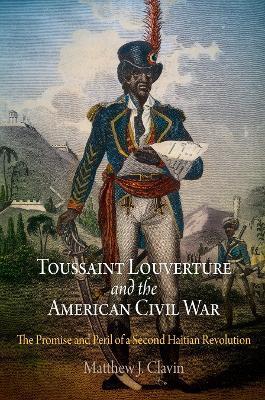
Toussaint Louverture and the American Civil War: The Promise and Peril of a Second Haitian Revolution
At the end of the eighteenth century, a massive slave revolt rocked French Saint Domingue, the most profitable European colony in the Americas. Under the leadership of the charismatic former slave François Dominique Toussaint Louverture, a disciplined and determined republican army, consisting almost entirely of rebel slaves, defeated all of its rivals and restored peace to the embattled territory. The slave uprising that we now refer to as the Haitian Revolution concluded on January 1, 1804, with the establishment of Haiti, the first "black republic" in the Western Hemisphere.
The Haitian Revolution cast a long shadow over the Atlantic world. In the United States, according to Matthew J. Clavin, there emerged two competing narratives that vied for the revolution's legacy. One emphasized vengeful African slaves committing unspeakable acts of violence against white men, women, and children. The other was the story of an enslaved people who, under the leadership of Louverture, vanquished their oppressors in an effort to eradicate slavery and build a new nation. Toussaint Louverture and the American Civil War examines the significance of these competing narratives in American society on the eve of and during the Civil War. Clavin argues that, at the height of the longstanding conflict between North and South, Louverture and the Haitian Revolution were resonant, polarizing symbols, which antislavery and proslavery groups exploited both to provoke a violent confrontation and to determine the fate of slavery in the United States. In public orations and printed texts, African Americans and their white allies insisted that the Civil War was a second Haitian Revolution, a bloody conflict in which thousands of armed bondmen, "American Toussaints," would redeem the republic by securing the abolition of slavery and proving the equality of the black race. Southern secessionists and northern anti-abolitionists responded by launching a cultural counterrevolution to prevent a second Haitian Revolution from taking place.
 GRATUIT CARGUS
PRP: 232.11 Lei

Acesta este Prețul Recomandat de Producător. Prețul de vânzare al produsului este afișat mai jos.
208.90Lei
208.90Lei
232.11 LeiPrimești 208 puncte
Indisponibil
Descrierea produsului
At the end of the eighteenth century, a massive slave revolt rocked French Saint Domingue, the most profitable European colony in the Americas. Under the leadership of the charismatic former slave François Dominique Toussaint Louverture, a disciplined and determined republican army, consisting almost entirely of rebel slaves, defeated all of its rivals and restored peace to the embattled territory. The slave uprising that we now refer to as the Haitian Revolution concluded on January 1, 1804, with the establishment of Haiti, the first "black republic" in the Western Hemisphere.
The Haitian Revolution cast a long shadow over the Atlantic world. In the United States, according to Matthew J. Clavin, there emerged two competing narratives that vied for the revolution's legacy. One emphasized vengeful African slaves committing unspeakable acts of violence against white men, women, and children. The other was the story of an enslaved people who, under the leadership of Louverture, vanquished their oppressors in an effort to eradicate slavery and build a new nation. Toussaint Louverture and the American Civil War examines the significance of these competing narratives in American society on the eve of and during the Civil War. Clavin argues that, at the height of the longstanding conflict between North and South, Louverture and the Haitian Revolution were resonant, polarizing symbols, which antislavery and proslavery groups exploited both to provoke a violent confrontation and to determine the fate of slavery in the United States. In public orations and printed texts, African Americans and their white allies insisted that the Civil War was a second Haitian Revolution, a bloody conflict in which thousands of armed bondmen, "American Toussaints," would redeem the republic by securing the abolition of slavery and proving the equality of the black race. Southern secessionists and northern anti-abolitionists responded by launching a cultural counterrevolution to prevent a second Haitian Revolution from taking place.Detaliile produsului



