








Two Roman Revolutions: The Senate, the Emperors and Power, from Commodus to Gallienus (AD 180-260)
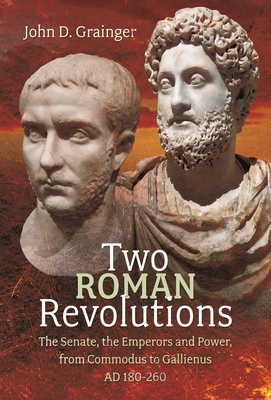
Two Roman Revolutions: The Senate, the Emperors and Power, from Commodus to Gallienus (AD 180-260)
Much has been written about the events of 69AD, the famous 'Year of Four Emperors', but this book offers a new perspective on the Roman Empire as the shift of power between Senate and Emperor turned deadly.
The disastrous reign of the Emperor Commodus, which saw a great expansion of the power of the emperor, eventually resulted in his asassination, but also in a civil war, which was as revolutionary as that of 69. Though the original assassination had been in the name of a restoration of the authority of the Senate - the program of Pertinax and his supporters - the victory of Septimius Severus established a murderous autocracy, which degenerated into incompetence under his successors. It also set up a continuous tension within the government between imperial and senatorial powers and authority.
The weakness of the imperial power after Caracalla was emphasised by the assassination of all emperors between 217 and 238; it also produced an increase in warfare on all frontiers from Syria to Britannia. In the later years of Alexander Severus the Senate began to recover its authority, thanks to the emperor's long absences from Rome in the east and in Germany. His frontier policy displeased the army, however, and his assassination produced the Emperor Maximinus. The recovery of the Senate was immediately stopped in its tracks and Maximinus disdained all authority apart from his own.
This was a classic prerevolutionary situation, and the reaction amongst the senators was the revolution of 238, sparked by trouble in Africa under the Gordians, but also producing another civil war and the deaths of several emperors. The authority of the Senate was enhanced by the senatorial victory but in in the end the Senate proved unable to defend the empire, and the contest between imperial and senatorial power continued until the 260s when in effect Gallienus returned to imperial autocracy.
This marked the end of real senatorial power, and the empire as an autocracy was finally established.
Much has been written about the events of 69AD, the famous 'Year of Four Emperors', but this book offers a new perspective on the Roman Empire as the shift of power between Senate and Emperor turned deadly.
The disastrous reign of the Emperor Commodus, which saw a great expansion of the power of the emperor, eventually resulted in his asassination, but also in a civil war, which was as revolutionary as that of 69. Though the original assassination had been
The disastrous reign of the Emperor Commodus, which saw a great expansion of the power of the emperor, eventually resulted in his asassination, but also in a civil war, which was as revolutionary as that of 69. Though the original assassination had been in the name of a restoration of the authority of the Senate - the program of Pertinax and his supporters - the victory of Septimius Severus established a murderous autocracy, which degenerated into incompetence under his successors. It also set up a continuous tension within the government between imperial and senatorial powers and authority.
The weakness of the imperial power after Caracalla was emphasised by the assassination of all emperors between 217 and 238; it also produced an increase in warfare on all frontiers from Syria to Britannia. In the later years of Alexander Severus the Senate began to recover its authority, thanks to the emperor's long absences from Rome in the east and in Germany. His frontier policy displeased the army, however, and his assassination produced the Emperor Maximinus. The recovery of the Senate was immediately stopped in its tracks and Maximinus disdained all authority apart from his own.
This was a classic prerevolutionary situation, and the reaction amongst the senators was the revolution of 238, sparked by trouble in Africa under the Gordians, but also producing another civil war and the deaths of several emperors. The authority of the Senate was enhanced by the senatorial victory but in in the end the Senate proved unable to defend the empire, and the contest between imperial and senatorial power continued until the 260s when in effect Gallienus returned to imperial autocracy.
This marked the end of real senatorial power, and the empire as an autocracy was finally established.
Much has been written about the events of 69AD, the famous 'Year of Four Emperors', but this book offers a new perspective on the Roman Empire as the shift of power between Senate and Emperor turned deadly.
The disastrous reign of the Emperor Commodus, which saw a great expansion of the power of the emperor, eventually resulted in his asassination, but also in a civil war, which was as revolutionary as that of 69. Though the original assassination had been
PRP: 229.09 Lei

Acesta este Prețul Recomandat de Producător. Prețul de vânzare al produsului este afișat mai jos.
183.27Lei
183.27Lei
229.09 LeiPrimești 183 puncte

Indisponibil
Descrierea produsului
Much has been written about the events of 69AD, the famous 'Year of Four Emperors', but this book offers a new perspective on the Roman Empire as the shift of power between Senate and Emperor turned deadly.
The disastrous reign of the Emperor Commodus, which saw a great expansion of the power of the emperor, eventually resulted in his asassination, but also in a civil war, which was as revolutionary as that of 69. Though the original assassination had been in the name of a restoration of the authority of the Senate - the program of Pertinax and his supporters - the victory of Septimius Severus established a murderous autocracy, which degenerated into incompetence under his successors. It also set up a continuous tension within the government between imperial and senatorial powers and authority.
The weakness of the imperial power after Caracalla was emphasised by the assassination of all emperors between 217 and 238; it also produced an increase in warfare on all frontiers from Syria to Britannia. In the later years of Alexander Severus the Senate began to recover its authority, thanks to the emperor's long absences from Rome in the east and in Germany. His frontier policy displeased the army, however, and his assassination produced the Emperor Maximinus. The recovery of the Senate was immediately stopped in its tracks and Maximinus disdained all authority apart from his own.
This was a classic prerevolutionary situation, and the reaction amongst the senators was the revolution of 238, sparked by trouble in Africa under the Gordians, but also producing another civil war and the deaths of several emperors. The authority of the Senate was enhanced by the senatorial victory but in in the end the Senate proved unable to defend the empire, and the contest between imperial and senatorial power continued until the 260s when in effect Gallienus returned to imperial autocracy.
This marked the end of real senatorial power, and the empire as an autocracy was finally established.
Much has been written about the events of 69AD, the famous 'Year of Four Emperors', but this book offers a new perspective on the Roman Empire as the shift of power between Senate and Emperor turned deadly.
The disastrous reign of the Emperor Commodus, which saw a great expansion of the power of the emperor, eventually resulted in his asassination, but also in a civil war, which was as revolutionary as that of 69. Though the original assassination had been
The disastrous reign of the Emperor Commodus, which saw a great expansion of the power of the emperor, eventually resulted in his asassination, but also in a civil war, which was as revolutionary as that of 69. Though the original assassination had been in the name of a restoration of the authority of the Senate - the program of Pertinax and his supporters - the victory of Septimius Severus established a murderous autocracy, which degenerated into incompetence under his successors. It also set up a continuous tension within the government between imperial and senatorial powers and authority.
The weakness of the imperial power after Caracalla was emphasised by the assassination of all emperors between 217 and 238; it also produced an increase in warfare on all frontiers from Syria to Britannia. In the later years of Alexander Severus the Senate began to recover its authority, thanks to the emperor's long absences from Rome in the east and in Germany. His frontier policy displeased the army, however, and his assassination produced the Emperor Maximinus. The recovery of the Senate was immediately stopped in its tracks and Maximinus disdained all authority apart from his own.
This was a classic prerevolutionary situation, and the reaction amongst the senators was the revolution of 238, sparked by trouble in Africa under the Gordians, but also producing another civil war and the deaths of several emperors. The authority of the Senate was enhanced by the senatorial victory but in in the end the Senate proved unable to defend the empire, and the contest between imperial and senatorial power continued until the 260s when in effect Gallienus returned to imperial autocracy.
This marked the end of real senatorial power, and the empire as an autocracy was finally established.
Much has been written about the events of 69AD, the famous 'Year of Four Emperors', but this book offers a new perspective on the Roman Empire as the shift of power between Senate and Emperor turned deadly.
The disastrous reign of the Emperor Commodus, which saw a great expansion of the power of the emperor, eventually resulted in his asassination, but also in a civil war, which was as revolutionary as that of 69. Though the original assassination had been
Detaliile produsului




