








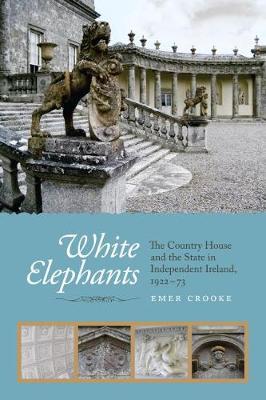
Grand, awe-inspiring and beautiful, the `Big House' is widely viewed as a jewel in the Irish landscape today. Despite this, the relationship between the country house and the state has long been complex and nuanced. Houses such as Castletown, Mote Park, and Shanbally Castle have faced sometimes insurmountable threats to their survival since the founding of the Free State. Against a backdrop of civil war and social upheaval, the fledging government of 1922 was unwilling to accept the burdensome gifts of these extravagant but ineffectual `white elephants' at a time when much of the population lived in poverty. From the 1920s to the 1970s, hundreds of former landlords' residences - often seen as symbols of British oppression - were sold on, demolished or simply abandoned to ruin. Despite the significant change that took place in terms of the perception of these houses as part of the national heritage, the relationship between the state post-independence and the country house has not been examined in detail to date.
Analysing previously unused government records, White Elephants illustrates the complex attitudes of politicians such as Erskine Childers, Sean Moylan and Charles J. Haughey to the country house and the crucial role of senior civil servants in determining their fates. The actions of the Office of Public Works and the Land Commission are here analysed and weighed, while the effects of land division and the alienation of the Anglo-Irish class are seen through the often-revealing lens of Department of the Taoiseach and Department of Finance files. These previously unmined sources uncover the more personal history and attitudes behind decisions for demolition or salvation.
Drawing on case studies of significant Irish houses including Bishopscourt, Derrynane, Dunsandle, Hazelwood, Killarney, Muckross and Russborough, White Elephants tracks the compelling development of the Irish country house from burden to heritage site, running in parallel with the development of Ireland from a fledgling state to taking its place in the international community of the EEC in 1973.
Analysing previously unused government records, White Elephants illustrates the complex attitudes of politicians such as Erskine Childers, Sean Moylan and Charles J. Haughey to the country house and the crucial role of senior civil servants in determining their fates. The actions of the Office of Public Works and the Land Commission are here analysed and weighed, while the effects of land division and the alienation of the Anglo-Irish class are seen through the often-revealing lens of Department of the Taoiseach and Department of Finance files. These previously unmined sources uncover the more personal history and attitudes behind decisions for demolition or salvation.
Drawing on case studies of significant Irish houses including Bishopscourt, Derrynane, Dunsandle, Hazelwood, Killarney, Muckross and Russborough, White Elephants tracks the compelling development of the Irish country house from burden to heritage site, running in parallel with the development of Ireland from a fledgling state to taking its place in the international community of the EEC in 1973.





