





Who Were the Early Israelites and Where Did They Come From?
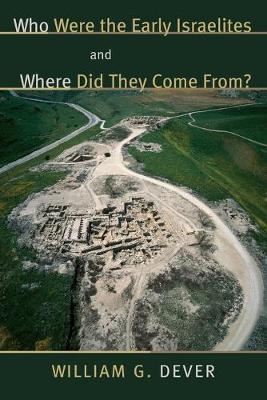
Who Were the Early Israelites and Where Did They Come From?
A respected archaeologist's engaging, revealing take on ancient Israel. A thorough yet readable examination of a much-debated subject -- of relevance also to the current Israeli-Palestinian situation -- this book is sure to reinvigorate discussion of the origins of ancient Israel.
This book addresses one of the most timely and urgent topics in archaeology and biblical studies -- the origins of early Israel. For centuries the Western tradition has traced its beginnings back to ancient Israel, but recently some historians and archaeologists have questioned the reality of Israel as it is described in biblical literature. In Who Were the Early Israelites and Where Did They Come From? William Dever explores the continuing controversies regarding the true nature of ancient Israel and presents the archaeological evidence for assessing the accuracy of the well-known Bible stories. Confronting the range of current scholarly interpretations seriously and dispassionately, Dever rejects both the revisionists who characterize biblical literature as "pious propaganda" and the conservatives who are afraid to even question its factuality. Attempting to break through this impasse, Dever draws on thirty years of archaeological fieldwork in the Near East, amassing a wide range of hard evidence for his own compelling view of the development of Israelite history. In his search for the actual circumstances of Israel's emergence in Canaan, Dever reevaluates the Exodus-Conquest traditions in the books of Exodus, Numbers, Joshua, Judges, and 1 & 2 Samuel in the light of well-documented archaeological evidence from the late Bronze Age and early Iron Age. Among this important evidence are some 300 small agricultural villages recently discovered in the heartland of what would later become the biblical nation of Israel. According to Dever, the authentic ancestors of the "Israelite peoples" were most likely Canaanites -- together with some pastoral nomads and small groups of Semitic slaves escaping from Egypt -- who, through the long cultural and socioeconomic struggles recounted in the book of Judges, managed to forge a new agrarian, communitarian, and monotheistic society. Written in an engaging, accessible style and featuring fifty photographs that help bring the archaeological record to life, this book provides an authoritative statement on the origins of ancient Israel and promises to reinvigorate discussion about the historicity of the biblical tradition.
This book addresses one of the most timely and urgent topics in archaeology and biblical studies -- the origins of early Israel. For centuries the Western tradition has traced its beginnings back to ancient Israel, but recently some historians and archaeologists have questioned the reality of Israel as it is described in biblical literature. In Who Were the Early Israelites and Where Did They Come From? William Dever explores the continuing controversies regarding the true nature of ancient Israel and presents the archaeological evidence for assessing the accuracy of the well-known Bible stories. Confronting the range of current scholarly interpretations seriously and dispassionately, Dever rejects both the revisionists who characterize biblical literature as "pious propaganda" and the conservatives who are afraid to even question its factuality. Attempting to break through this impasse, Dever draws on thirty years of archaeological fieldwork in the Near East, amassing a wide range of hard evidence for his own compelling view of the development of Israelite history. In his search for the actual circumstances of Israel's emergence in Canaan, Dever reevaluates the Exodus-Conquest traditions in the books of Exodus, Numbers, Joshua, Judges, and 1 & 2 Samuel in the light of well-documented archaeological evidence from the late Bronze Age and early Iron Age. Among this important evidence are some 300 small agricultural villages recently discovered in the heartland of what would later become the biblical nation of Israel. According to Dever, the authentic ancestors of the "Israelite peoples" were most likely Canaanites -- together with some pastoral nomads and small groups of Semitic slaves escaping from Egypt -- who, through the long cultural and socioeconomic struggles recounted in the book of Judges, managed to forge a new agrarian, communitarian, and monotheistic society. Written in an engaging, accessible style and featuring fifty photographs that help bring the archaeological record to life, this book provides an authoritative statement on the origins of ancient Israel and promises to reinvigorate discussion about the historicity of the biblical tradition.
PRP: 198.34 Lei

Acesta este Prețul Recomandat de Producător. Prețul de vânzare al produsului este afișat mai jos.
178.51Lei
178.51Lei
198.34 LeiPrimești 178 puncte
Livrare in 2-4 saptamani
Descrierea produsului
A respected archaeologist's engaging, revealing take on ancient Israel. A thorough yet readable examination of a much-debated subject -- of relevance also to the current Israeli-Palestinian situation -- this book is sure to reinvigorate discussion of the origins of ancient Israel.
This book addresses one of the most timely and urgent topics in archaeology and biblical studies -- the origins of early Israel. For centuries the Western tradition has traced its beginnings back to ancient Israel, but recently some historians and archaeologists have questioned the reality of Israel as it is described in biblical literature. In Who Were the Early Israelites and Where Did They Come From? William Dever explores the continuing controversies regarding the true nature of ancient Israel and presents the archaeological evidence for assessing the accuracy of the well-known Bible stories. Confronting the range of current scholarly interpretations seriously and dispassionately, Dever rejects both the revisionists who characterize biblical literature as "pious propaganda" and the conservatives who are afraid to even question its factuality. Attempting to break through this impasse, Dever draws on thirty years of archaeological fieldwork in the Near East, amassing a wide range of hard evidence for his own compelling view of the development of Israelite history. In his search for the actual circumstances of Israel's emergence in Canaan, Dever reevaluates the Exodus-Conquest traditions in the books of Exodus, Numbers, Joshua, Judges, and 1 & 2 Samuel in the light of well-documented archaeological evidence from the late Bronze Age and early Iron Age. Among this important evidence are some 300 small agricultural villages recently discovered in the heartland of what would later become the biblical nation of Israel. According to Dever, the authentic ancestors of the "Israelite peoples" were most likely Canaanites -- together with some pastoral nomads and small groups of Semitic slaves escaping from Egypt -- who, through the long cultural and socioeconomic struggles recounted in the book of Judges, managed to forge a new agrarian, communitarian, and monotheistic society. Written in an engaging, accessible style and featuring fifty photographs that help bring the archaeological record to life, this book provides an authoritative statement on the origins of ancient Israel and promises to reinvigorate discussion about the historicity of the biblical tradition.
This book addresses one of the most timely and urgent topics in archaeology and biblical studies -- the origins of early Israel. For centuries the Western tradition has traced its beginnings back to ancient Israel, but recently some historians and archaeologists have questioned the reality of Israel as it is described in biblical literature. In Who Were the Early Israelites and Where Did They Come From? William Dever explores the continuing controversies regarding the true nature of ancient Israel and presents the archaeological evidence for assessing the accuracy of the well-known Bible stories. Confronting the range of current scholarly interpretations seriously and dispassionately, Dever rejects both the revisionists who characterize biblical literature as "pious propaganda" and the conservatives who are afraid to even question its factuality. Attempting to break through this impasse, Dever draws on thirty years of archaeological fieldwork in the Near East, amassing a wide range of hard evidence for his own compelling view of the development of Israelite history. In his search for the actual circumstances of Israel's emergence in Canaan, Dever reevaluates the Exodus-Conquest traditions in the books of Exodus, Numbers, Joshua, Judges, and 1 & 2 Samuel in the light of well-documented archaeological evidence from the late Bronze Age and early Iron Age. Among this important evidence are some 300 small agricultural villages recently discovered in the heartland of what would later become the biblical nation of Israel. According to Dever, the authentic ancestors of the "Israelite peoples" were most likely Canaanites -- together with some pastoral nomads and small groups of Semitic slaves escaping from Egypt -- who, through the long cultural and socioeconomic struggles recounted in the book of Judges, managed to forge a new agrarian, communitarian, and monotheistic society. Written in an engaging, accessible style and featuring fifty photographs that help bring the archaeological record to life, this book provides an authoritative statement on the origins of ancient Israel and promises to reinvigorate discussion about the historicity of the biblical tradition.
Detaliile produsului



