


- /
- Librarie online
- /
- Carti in engleza
- /
- Computers
- /
- Software Development & Engineering
- /
- Systems Analysis & Design
- /
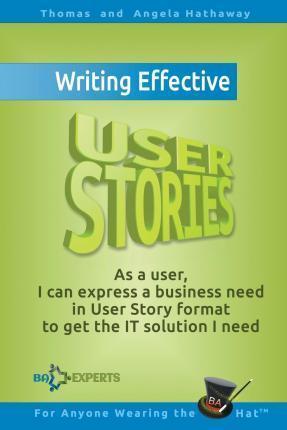
- Writing Effective User Stories: As a User, I Can Express a Business Need in User Story Format To Get the IT Solution I Need - Angela Hathaway
Writing Effective User Stories: As a User, I Can Express a Business Need in User Story Format To Get the IT Solution I Need
Writing Effective User Stories: As a User, I Can Express a Business Need in User Story Format To Get the IT Solution I Need
User Stories are a great method for expressing stakeholder requirements, whether your projects follow an Agile, Iterative, or a Waterfall methodology. They are the basis for developers to deliver a suitable information technology (IT) app or application. Well-structured user stories express a single action to achieve a specific goal from the perspective of a single role. When writing user stories, stakeholders knowledgeable about the role should focus on the business result that the IT solution will enable while leaving technology decisions up to the developers. Good user stories are relevant to the project, unambiguous, and understandable to knowledge peers. The best user stories also contain crucial non-functional (quality) requirements, which are the best weapon in the war against unsatisfactory performance in IT solutions. This book presents two common User Story structures to help you ensure that your User Stories have all the required components and that they express the true business need as succinctly as possible. It offers 5 simple rules to ensure that your User Stories are the best that they can be. That, in turn, will reduce the amount of time needed in User Story elaboration and discussion with the development team. After reading this book you will be able to: Translate business needs into well-structured User Stories Write User Stories that express the what and avoid the how Apply five simple rules for writing effective User Stories Clarify assumptions in User Stories by adding context Identify and remove ambiguous and subjective terms and phrases in User Stories Select the appropriate format for expressing User Stories for Agile Projects Write stakeholder requirements in User Story format that solve business problems Elaborate User Stories to identify measurable non-functional requirementsAUTHOR'S NOTE: The term "User Story" is a relative new addition to our language and its definition is evolving. In today's parlance, a complete User Story has three primary components, namely the "Card", the "Conversation", and the "Criteria". Different roles are responsible for creating each component. The "Card" expresses a business need. A representative of the business community is responsible for expressing the business need. Historically (and for practical reasons) the "Card" is the User Story from the perspective of the business community. Since we wrote this book specifically to address that audience, we use the term "User Story" in that c
PRP: 69.67 Lei

Acesta este Prețul Recomandat de Producător. Prețul de vânzare al produsului este afișat mai jos.
62.70Lei
62.70Lei
69.67 LeiPrimești 62 puncte

Indisponibil
Descrierea produsului
User Stories are a great method for expressing stakeholder requirements, whether your projects follow an Agile, Iterative, or a Waterfall methodology. They are the basis for developers to deliver a suitable information technology (IT) app or application. Well-structured user stories express a single action to achieve a specific goal from the perspective of a single role. When writing user stories, stakeholders knowledgeable about the role should focus on the business result that the IT solution will enable while leaving technology decisions up to the developers. Good user stories are relevant to the project, unambiguous, and understandable to knowledge peers. The best user stories also contain crucial non-functional (quality) requirements, which are the best weapon in the war against unsatisfactory performance in IT solutions. This book presents two common User Story structures to help you ensure that your User Stories have all the required components and that they express the true business need as succinctly as possible. It offers 5 simple rules to ensure that your User Stories are the best that they can be. That, in turn, will reduce the amount of time needed in User Story elaboration and discussion with the development team. After reading this book you will be able to: Translate business needs into well-structured User Stories Write User Stories that express the what and avoid the how Apply five simple rules for writing effective User Stories Clarify assumptions in User Stories by adding context Identify and remove ambiguous and subjective terms and phrases in User Stories Select the appropriate format for expressing User Stories for Agile Projects Write stakeholder requirements in User Story format that solve business problems Elaborate User Stories to identify measurable non-functional requirementsAUTHOR'S NOTE: The term "User Story" is a relative new addition to our language and its definition is evolving. In today's parlance, a complete User Story has three primary components, namely the "Card", the "Conversation", and the "Criteria". Different roles are responsible for creating each component. The "Card" expresses a business need. A representative of the business community is responsible for expressing the business need. Historically (and for practical reasons) the "Card" is the User Story from the perspective of the business community. Since we wrote this book specifically to address that audience, we use the term "User Story" in that c
Detaliile produsului