





De Anima
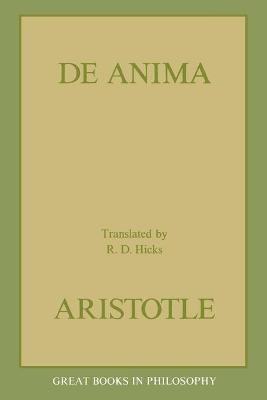
De Anima
Like many cultures then and now, the early Greeks pondered the nature of the soul. Originally conceived as a kind of ghost, surviving in a bloodless existence after the death of the body, the soul was defined by later philosophers - notably the Pythagoreans and Plato - as an immaterial divine being temporarily "imprisoned" in the body. True knowledge was gained not through the senses but from contemplation of external Ideas that were, like the soul itself, immaterial and immortal.
A reformulation as well as a criticism of earlier thinkers, Aristotle's De Anima describes soul and body as complementaries rather than polar opposites, as they stand together in a mutual relation of matter and form. Each living entity, endowed with its own animating and informing principle, realizes its proper end. The human soul, incorporating all the animate properties of the lower life forms - the nutritive, propagative, locomotive, and perceptive - has also a fifth power, the intellective. The mind, to which the fifth and highest part is devoted, is alone capable of forming ideas of abstract concepts and relations. Hence, the human mind alone remains free from union with the corporeal.
A reformulation as well as a criticism of earlier thinkers, Aristotle's De Anima describes soul and body as complementaries rather than polar opposites, as they stand together in a mutual relation of matter and form. Each living entity, endowed with its own animating and informing principle, realizes its proper end. The human soul, incorporating all the animate properties of the lower life forms - the nutritive, propagative, locomotive, and perceptive - has also a fifth power, the intellective. The mind, to which the fifth and highest part is devoted, is alone capable of forming ideas of abstract concepts and relations. Hence, the human mind alone remains free from union with the corporeal.
PRP: 97.09 Lei

Acesta este Prețul Recomandat de Producător. Prețul de vânzare al produsului este afișat mai jos.
87.38Lei
87.38Lei
97.09 LeiPrimești 87 puncte
Livrare in 2-4 saptamani
Descrierea produsului
Like many cultures then and now, the early Greeks pondered the nature of the soul. Originally conceived as a kind of ghost, surviving in a bloodless existence after the death of the body, the soul was defined by later philosophers - notably the Pythagoreans and Plato - as an immaterial divine being temporarily "imprisoned" in the body. True knowledge was gained not through the senses but from contemplation of external Ideas that were, like the soul itself, immaterial and immortal.
A reformulation as well as a criticism of earlier thinkers, Aristotle's De Anima describes soul and body as complementaries rather than polar opposites, as they stand together in a mutual relation of matter and form. Each living entity, endowed with its own animating and informing principle, realizes its proper end. The human soul, incorporating all the animate properties of the lower life forms - the nutritive, propagative, locomotive, and perceptive - has also a fifth power, the intellective. The mind, to which the fifth and highest part is devoted, is alone capable of forming ideas of abstract concepts and relations. Hence, the human mind alone remains free from union with the corporeal.
A reformulation as well as a criticism of earlier thinkers, Aristotle's De Anima describes soul and body as complementaries rather than polar opposites, as they stand together in a mutual relation of matter and form. Each living entity, endowed with its own animating and informing principle, realizes its proper end. The human soul, incorporating all the animate properties of the lower life forms - the nutritive, propagative, locomotive, and perceptive - has also a fifth power, the intellective. The mind, to which the fifth and highest part is devoted, is alone capable of forming ideas of abstract concepts and relations. Hence, the human mind alone remains free from union with the corporeal.
Detaliile produsului



