- /
- Librarie online
- /
- Carti in engleza
- /
- Art
- /
- History
- /
- Modern (late 19th Century To 1945)
- /
- M. C. Escher. l'Oeuvre Graphique - Taschen
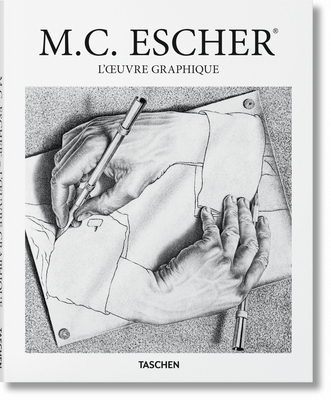
M. C. Escher. l'Oeuvre Graphique
M. C. Escher. l'Oeuvre Graphique
From impossible staircases to tesselated birds, Dutch artist M.C. Escher (1898-1972) crafted a unique graphic language of patterns, puzzles, and mathematics. Dense, complex, and structured by intricate principles, his work is at the same time decorative and playful, toying constantly with optic illusions and the limitations of sensory perception. For mathematicians and scientists, Escher is a mastermind. For hippies, he was the pioneer of psychedelic art.Born in Leeuwarden, in the Netherlands in 1898, Escher's early works focused on nature and landscapes, with regular exhibitions in Holland, and some international recognition. It was on a trip to the Alhambra Palace in Spain in the 1920s, however, that Escher found his niche. Sketching the patterns of the palace's Moorish architecture, Escher became captivated by the codependency of forms within and next to each other.Working mainly with lithographs and woodcuts, Escher went on to explore the relationships among shapes, figures, and space with a near-obsessive delight. He reveled in quirky vantage points, multiple perspectives, the transition from paper flatness to illusory volume, and intricate mathematical puzzles such as the M bius strip, a seemingly infinite loop which twists and recoils on itself in a contortion of apparent physical impossibility.This introductory book from TASCHEN Basic Art 2.0 taps into Escher's brilliant mind with key works from his restless investigation of image and perception. Along the way, you'll find fish morphing into birds, lizards crawling off the page, masterful reflections, infinite mazes, and some of the most mind-bending images of 20th-century art.
Des escaliers impossibles aux oiseaux en pavage, l'artiste n erlandais M.C. Escher (1898-1972) a labor un vocabulaire graphique o les ma tre-mots sont motif, casse-t te et math matiques. Riches, complexes et structur es par des principes d'imbrication, ses cr ations sont galement d coratives et ludiques, jouant constamment sur les illusions d'optique et les limites de notre perception sensorielle. Aux yeux des math maticiens et des scientifiques, Escher est un g nie. Aux yeux des hippies, il fait figure de pionnier de l'art psych d lique.Les premi res oeuvres d'Escher, n Leeuwarden, aux Pays-Bas, en 1898, portaient sur la nature et les paysages, et faisaient d j l'objet de fr quentes expositions en Hollande et d'une certaine reconnaissance dans le monde. C'est pourtant lors d'un voyage au palais de l'Alhambra
PRP: 140.40 Lei

Acesta este Prețul Recomandat de Producător. Prețul de vânzare al produsului este afișat mai jos.
112.32Lei
112.32Lei
140.40 LeiPrimești 112 puncte

Livrare in 2-4 saptamani
Descrierea produsului
From impossible staircases to tesselated birds, Dutch artist M.C. Escher (1898-1972) crafted a unique graphic language of patterns, puzzles, and mathematics. Dense, complex, and structured by intricate principles, his work is at the same time decorative and playful, toying constantly with optic illusions and the limitations of sensory perception. For mathematicians and scientists, Escher is a mastermind. For hippies, he was the pioneer of psychedelic art.Born in Leeuwarden, in the Netherlands in 1898, Escher's early works focused on nature and landscapes, with regular exhibitions in Holland, and some international recognition. It was on a trip to the Alhambra Palace in Spain in the 1920s, however, that Escher found his niche. Sketching the patterns of the palace's Moorish architecture, Escher became captivated by the codependency of forms within and next to each other.Working mainly with lithographs and woodcuts, Escher went on to explore the relationships among shapes, figures, and space with a near-obsessive delight. He reveled in quirky vantage points, multiple perspectives, the transition from paper flatness to illusory volume, and intricate mathematical puzzles such as the M bius strip, a seemingly infinite loop which twists and recoils on itself in a contortion of apparent physical impossibility.This introductory book from TASCHEN Basic Art 2.0 taps into Escher's brilliant mind with key works from his restless investigation of image and perception. Along the way, you'll find fish morphing into birds, lizards crawling off the page, masterful reflections, infinite mazes, and some of the most mind-bending images of 20th-century art.
Des escaliers impossibles aux oiseaux en pavage, l'artiste n erlandais M.C. Escher (1898-1972) a labor un vocabulaire graphique o les ma tre-mots sont motif, casse-t te et math matiques. Riches, complexes et structur es par des principes d'imbrication, ses cr ations sont galement d coratives et ludiques, jouant constamment sur les illusions d'optique et les limites de notre perception sensorielle. Aux yeux des math maticiens et des scientifiques, Escher est un g nie. Aux yeux des hippies, il fait figure de pionnier de l'art psych d lique.Les premi res oeuvres d'Escher, n Leeuwarden, aux Pays-Bas, en 1898, portaient sur la nature et les paysages, et faisaient d j l'objet de fr quentes expositions en Hollande et d'une certaine reconnaissance dans le monde. C'est pourtant lors d'un voyage au palais de l'Alhambra
Detaliile produsului